What happens when you bring together 300+ of the most forward-thinking fleet managers, government leaders, and industry innovators under one roof? You get the FLAGFA Fall Conference 2025—an energizing mix of leadership lessons, cutting-edge technology, and collaborative problem-solving.
Held at the Tradewinds Isle Grand Resort, this year’s conference delivered two packed days of inspiration, networking, and tangible strategies for fleet professionals tasked with keeping local government operations moving. From a gripping keynote by Captain Richard Phillips to practical fleet leadership sessions, the event reaffirmed why FLAGFA remains one of the most valuable conferences in the fleet industry.
In this recap, we’ll walk you through the highlights: the powerful leadership takeaways, the future of AI in fleet management, the best practices shared by top-performing fleet managers, and the 100-vendor expo that showcased everything from diagnostics to new technologies.
Leadership Lessons from the Front Lines
Key Insight: Fleet management isn’t just about vehicles—it’s about people and leadership.
Captain Richard Phillips opened Thursday with a riveting account of his 2009 hijacking by Somali pirates. His story wasn’t just about survival—it was about calm decision-making under extreme pressure. The parallels to fleet management were clear: leaders are defined not in easy times but in moments of crisis.
Colonel Garth Massey of the U.S. Marines followed with his Command Ready leadership framework. His message was direct: discipline, clarity, and mission-first leadership principles apply as much to fleet shops as they do to military operations.
Real-World Application: Fleet managers often juggle shrinking budgets, rising demands, and rapidly advancing technology. By applying Phillips’ and Massey’s leadership principles—decisiveness, preparation, and resilience—leaders can guide their teams with confidence even in high-pressure environments.
While the morning focused on leadership under fire, the afternoon shifted gears into a different kind of challenge: understanding the technology reshaping the world around us. Before fleet leaders can decide how—or when—to use Artificial Intelligence in their operations, they first need to understand what AI actually is. That’s where Jeff Butler’s session came in.
Understanding the Foundations of AI
Key Insight: Before we can apply AI in fleet management—or any industry—we need to understand what it really is.
Jeff Butler’s session didn’t focus on use cases or predictive analytics. Instead, he took attendees back to basics, unpacking the fundamentals of Artificial Intelligence for an audience where many were just beginning to explore the concept.
He explained AI as the science of creating systems that can “think” or “learn” in ways that mimic human intelligence—whether through recognizing patterns, processing language, or solving problems faster than traditional software. Butler highlighted how we already interact with AI daily without realizing it: voice assistants, online recommendations, and even email spam filters are powered by it.
Analogy for Beginners: Think of AI as a student who never stops learning. The more data you feed it, the better it gets at recognizing patterns and making decisions—much like a mechanic who improves after diagnosing thousands of vehicles.
Common Misconception: AI isn’t magic, nor is it replacing humans overnight. It’s a set of tools that still depend on human oversight, quality data, and context to be effective.
Takeaway for Fleet Professionals: Even if you’re not ready to adopt AI-driven tools, understanding its foundations prepares you for the inevitable changes coming to technology, vehicles, and operations. Awareness is the first step toward making informed choices in the future.
After getting a broad introduction to the future of technology, the conference shifted back to the here-and-now of running a fleet. Because while AI may be on the horizon, the day-to-day challenges fleet managers face—leading teams, managing people, and keeping operations efficient—remain the foundation of success.
Lessons from Fleet Leaders in the Field
Key Insight: Success isn’t about technology alone—it’s about team culture.
Fleet managers Jeff Hawthorne and Jeff Butler (speaking as practitioners, not consultants) shared raw insights into building resilient, motivated teams. Their advice included:
Document processes to reduce errors and downtime.
Invest in technician growth—training creates loyalty.
Communicate vision clearly so teams understand how their work supports larger goals.
Measure performance beyond cost-per-mile: include uptime, safety, and employee satisfaction.
Success Metrics Example: A fleet that reduced downtime by 20% after standardizing diagnostic workflows and reinvesting savings into technician training.
Innovation on Display at the Vendor Expo
Key Insight: The expo floor showcased the diversity of products and services that keep government fleets running efficiently.
Unlike some conferences that focus narrowly on one segment, the FLAGFA vendor expo offered a wide lens on today’s fleet solutions. Nearly 100 vendors were present, representing everything from vehicle upfitting and fleet management software to accessories and specialized equipment.
Walking the floor, attendees could see:
Upfitting Companies demonstrating the latest in lighting, storage, and safety solutions for municipal vehicles.
Fleet Management Software Providers offering platforms to streamline scheduling, reporting, and compliance.
Vehicle Accessories that improve usability and operator comfort.
On-Vehicle Equipment like a brake rotor lathe designed for service efficiency.
Outdoor Vehicle Displays ranging from a vacuum truck and trash collection to a patrol boat and police vehicles—giving managers a hands-on look at real-world assets.
The Value for Attendees: For fleet managers, the expo wasn’t just about browsing products—it was about finding practical, budget-conscious solutions to everyday challenges. Being able to compare tools side-by-side, ask questions directly, and see equipment in action offered insights impossible to get from a brochure or website.
KEY TAKEAWAYS BOX
Leadership under pressure matters: Lessons from Phillips and Massey apply directly to fleet shops.
AI is here now: Smart fleets are starting with small wins before scaling.
Culture drives performance: Process, training, and communication unlock sustainable success.
The expo fuels innovation: Vendors provide the technology bridge to the fleets of tomorrow.
CONCLUSION
The FLAGFA Fall Conference wasn’t just another industry event—it was a reminder that fleet management is equal parts leadership, technology, and teamwork. From pirate ships to predictive analytics, the stories and strategies shared last week will help shape smarter, stronger government fleets across Florida and beyond.
As Defy Diagnostics, we’re proud to be part of this community—showcasing solutions, learning from peers, and contributing to the shared mission of keeping fleets efficient and future-ready.
We look forward to seeing everyone again in March at the FLAGFASpring Conference in Daytona Beach. Until then, the challenge is clear: take the lessons learned here and put them into action.
What leadership or technology takeaway are you most excited to bring back to your fleet? Share in the comments below.
Picture this: A client rolls their $400,000 Ferrari SF90 into your shop with an intermittent hybrid system fault. The dealership quoted them $8,000 for diagnostics alone, citing “complex programming requirements” and a three-week wait. Your reputation—and a substantial profit opportunity—hangs on having the right diagnostic tool.
In the rarified world of supercar diagnostics, two platforms dominate the conversation among serious technicians: TEXA’s IDC6 ecosystem and Leonardo’s specialized exotic tool. Both claim “dealer-level” capabilities, yet their approaches couldn’t be more different. One offers comprehensive multi-brand coverage with AI-powered intelligence, while the other provides laser-focused specialization for Italian exotics. As we dive deeper into this TEXA vs Leonardo comparison, you’ll discover the strengths and weaknesses of each platform.
After analyzing real-world usage data, competitive intelligence reports, and direct technician feedback, we’ve uncovered the critical differences that separate these platforms. This analysis will reveal which tool truly delivers superior value for high-end automotive service, and why your choice could determine your shop’s future in the luxury automotive market.
Here’s what we’ll examine:
the fundamental philosophy driving each platform
real-world performance in complex diagnostic scenarios
total cost of ownership over five years
strategic advantages that position one tool as the clear winner for most professional operations
Section 1: The Great Divide – Philosophy and Market Approach
The fundamental difference between Texa and Leonardo isn’t just technical, it’s philosophical. This distinction shapes everything from user experience to long-term business viability.
TEXA’s Ecosystem Philosophy
Texa IDC6 operates on a “one platform, multiple worlds” philosophy. The system treats supercar diagnostics as one component of a comprehensive automotive service ecosystem. With AI-powered search capabilities and cross-platform integration spanning cars, trucks, marine, and off-highway vehicles, Texa positions itself as the Swiss Army knife of professional diagnostics.
The numbers support this approach. Independent shops using TEXA report handling more vehicle types on average compared to specialized-tool competitors. The IDC6’s AI Global Search feature queries of repair solutions across all platforms, meaning a technician diagnosing a Lamborghini Huracán can instantly access relevant data from similar systems in other high-performance vehicles.
Leonardo’s Specialization Strategy
Leonardo takes the opposite approach: absolute specialization in European exotics. Built by Italian engineers at Giovanni Accinni S.r.l. specifically for Ferrari, Maserati, Lamborghini, McLaren, and Aston Martin, Leonardo argues that depth trumps breadth. Their “industry standard” positioning targets shops that live or die by exotic vehicle service.
The TEXA vs Leonardo debate is essential for any technician looking to navigate the luxury automotive market effectively.
The tool’s strength lies in its obsessive focus. Leonardo offers dealer-level functions like Proxi Programming and PIS clutch settings that generic tools simply cannot perform. For shops specializing exclusively in exotics, this depth creates genuine competitive advantages.
Real-World Performance Comparison
A case study from a South Carolina Ferrari specialist illustrates the difference. Using Leonardo, the shop successfully performed a complex F1 gearbox self-learn procedure on a 430 Scuderia—a function requiring precise timing and proprietary protocols. The same shop later acquired TEXA IDC6 and found themselves able to service not just Ferraris, but also the Porsche Turbos, BMW M cars, and Mercedes-AMG vehicles their high-net-worth clients owned.
The verdict from their service manager: “Leonardo made us the Ferrari experts. TEXA made us the experts our clients’ garages needed.”
This philosophical divide creates the first critical decision point: Do you want to be the best at a few things, or exceptional at many?
Section 2: Technical Capabilities Deep Dive
Moving beyond philosophy to pure technical performance, both platforms offer sophisticated capabilities, but with markedly different implementation strategies.
TEXA’s defining technical advantage lies in its artificial intelligence integration. The AI Smart Diagnosis feature doesn’t just read codes—it analyzes patterns, suggests probable causes, and provides step-by-step resolution paths. In complex hybrid supercars like the McLaren Artura or Ferrari SF90, this intelligence proves invaluable.
Consider a real scenario: A 2024 Ferrari 296 GTB arrives with multiple intermittent faults across the hybrid system. Traditional diagnostic approaches require hours of manual cross-referencing between mechanical and electrical systems. TEXA’s AI immediately identifies the pattern as consistent with a specific high-voltage isolation fault, provides the exact testing sequence, and links to verified repair solutions from similar cases.
The system supports advanced protocols including DoIP (Diagnosis over Internet Protocol) and CAN-FD, ensuring compatibility with the latest electronic architectures. TEXA’s multi-level diagnostic support handles everything from basic code reading to secure gateway access on the newest platforms.
Leonardo’s technical strength lies in its reverse-engineered depth for specific brands. The tool essentially replicates—and in some cases exceeds—OEM diagnostic capabilities. For older Ferraris, this advantage is substantial. The system can perform functions like clutch adaptation on F355 models that even modern Ferrari tools struggle with.
The H4 hardware features a 15.6-inch touchscreen with one-button “Quick Test” functionality and real-time parameter viewing across all ECU modules.
Leonardo’s Bluetooth VCI offers 100-meter range, enabling remote monitoring during test drives—a practical advantage when diagnosing intermittent performance issues in high-performance vehicles.
Protocol Support and Future-Proofing
Here, the platforms diverge significantly. TEXA supports modern communication standards including DoIP, PassThru, and CAN-FD, ensuring compatibility with emerging vehicle technologies. The system’s subscription model guarantees continuous protocol updates as manufacturers implement new standards.
Leonardo focuses on established protocols for its target brands, with updates tied to specific model releases. While this approach works well for current exotic vehicles, it creates potential obsolescence risks as manufacturers transition to software-defined architectures.
Multi-brand diagnostics: TEXA dramatically outperforms (400% more efficient when handling diverse vehicle types)
AI-assisted troubleshooting: TEXA exclusive advantage (reduces diagnostic time by 23% average)
The technical verdict depends entirely on your service mix. For exotic specialists, Leonardo’s depth provides measurable advantages. For comprehensive operations, TEXA’s breadth and intelligence create superior overall efficiency.
Section 3: The Economics of Excellence – Total Cost Analysis
The financial analysis reveals the most dramatic differences between these platforms, with implications extending far beyond initial purchase price.
TEXA: Transparent Value Proposition
TEXA’s pricing structure follows a conventional model: significant upfront hardware investment with predictable annual software renewals. The AXONE VOICE tablet runs approximately $5,100, with the NAVIGATOR TXT MULTIHUB 2 interface adding another $2,600. Annual TEXPACK renewals typically cost $1,295 for comprehensive coverage including premium repair content.
The key advantage lies in bundling efficiency. A single TEXA investment can cover cars, supercars, trucks, marine, and off-highway vehicles. For shops serving diverse clientele, this consolidation eliminates the need for multiple specialized tools.
Leonardo: Premium Specialization Pricing
Leonardo’s pricing reflects its ultra-premium positioning. The H4 base system with Ferrari and Maserati software costs $19,995. However, the real financial impact emerges through the modular expansion model:
McLaren addition: $18,995
Individual Ferrari models (SF90, 296 GTB): $2,995-$4,995 each
Lamborghini modern models: $4,995 each
Annual renewals: $1,000 per brand
A shop wanting comprehensive exotic coverage faces potential investments exceeding $50,000 before annual renewals.
Five-Year Total Cost of Ownership Analysis
Consider two scenarios:
Scenario A: Mixed Luxury Service (Ferrari, Porsche, BMW M, Mercedes-AMG)
TEXA Total: $14,600 (hardware + 5-year renewals)
Leonardo Total: $34,990 (limited to Ferrari/Maserati only)
Scenario B: Ferrari Specialist
TEXA Total: $14,600 (same comprehensive coverage)
Leonardo Total: $24,995 (Ferrari-only coverage)
The analysis reveals Leonardo’s financial model works only for highly specialized operations with substantial exotic volume. Even Ferrari specialists face questionable ROI unless handling dozens of complex jobs annually.
Hidden Costs and Financial Risks
Leonardo’s biggest financial risk lies in forced hardware obsolescence. The company’s announcement that H2/H3 hardware reaches end-of-life in July 2025 creates immediate upgrade pressure. Existing customers must pay $9,995 for H4 upgrades or lose their investment entirely.
TEXA’s subscription model, while requiring annual renewals, doesn’t force hardware replacement. The platform’s continuous update approach extends hardware lifecycles and protects customer investments.
Return on Investment Calculations
Industry data shows the average exotic diagnostic job generates $380-$650 in labor revenue. Assuming modest volume (2 complex exotic jobs monthly), the financial comparison becomes clear:
TEXA pays for itself in 19 jobs while providing universal coverage
Leonardo requires 31+ jobs just to reach break-even on Ferrari-only coverage
For most operations, TEXA’s superior ROI creates compelling business advantages.
Section 4: Strategic Advantages and Competitive Positioning
The long-term strategic implications of choosing between these platforms extend far beyond immediate technical capabilities.
TEXA’s Strategic Moat: Ecosystem Integration
TEXA’s greatest strategic advantage lies in its comprehensive ecosystem approach. The platform doesn’t just diagnose vehicles—it integrates with broader shop management systems, provides extensive repair databases, and offers multi-industry scaling opportunities.
The AI integration creates a sustainable competitive advantage. As TEXA’s database grows through user interactions, the system becomes increasingly intelligent. This network effect means early adopters benefit from continuous improvement without additional investment.
TEXA’s protocol future-proofing strategy positions shops for emerging technologies. With manufacturers transitioning toward software-defined vehicles, TEXA’s investment in advanced protocols ensures continued relevance.
Leonardo’s Specialization Advantage
Leonardo’s strategic strength lies in its entrenched position within the exotic specialist community. The tool’s reputation creates genuine customer acquisition advantages—clients specifically seek shops with Leonardo capabilities.
The annual training program builds technical competency that competitors struggle to match. Shops using Leonardo often become recognized experts in their markets, commanding premium rates for specialized knowledge.
However, this specialization creates strategic vulnerability. As exotic vehicle ownership patterns evolve and clients diversify their collections, specialist shops risk losing customers to more comprehensive service providers.
Market Evolution and Future Positioning
Three trends threaten specialized diagnostic approaches:
Portfolio Diversification: Supercar owners increasingly maintain diverse collections spanning multiple brands and performance categories
Electrification: Hybrid supercars require different diagnostic approaches than traditional exotics
Service Consolidation: High-net-worth clients prefer comprehensive service relationships over multiple specialist relationships
TEXA’s platform architecture addresses these trends directly. The system’s multi-brand capabilities, EV diagnostic features, and comprehensive coveragealign with market evolution.
Leonardo faces adaptation challenges. While excellent for current exotic diagnostics, the platform’s narrow focus may become less relevant as the market shifts toward diversified, electrified high-performance vehicles.
Competitive Responses and Market Dynamics
The diagnostic tool market continues consolidating around comprehensive platforms. Snap-on, Autel, and other major players increasingly emphasize multi-brand coverage with specialized modules rather than single-purpose tools.
This trend favors TEXA’s ecosystem approach while pressuring specialized tools like Leonardo. Market dynamics suggest comprehensive platforms will capture increasing market share as shops seek operational efficiency and financial flexibility.
Key Takeaways
Platform Philosophy Drives Everything: TEXA’s ecosystem approach delivers superior versatility and ROI for most operations, while Leonardo’s specialization serves ultra-niche exotic specialists
Financial Reality Check: Leonardo’s total cost of ownership can exceed $50,000 for comprehensive coverage, while TEXA provides universal diagnostic capabilities for under $15,000 over five years
Technical Capabilities Match Use Cases: Leonardo offers superior depth for specific exotic functions, but TEXA’s AI-powered intelligence and broader protocol support create advantages across diverse scenarios
Strategic Future-Proofing: TEXA’s investment in advanced protocols and AI positions shops for market evolution, while Leonardo’s specialization faces increasing relevance challenges
Conclusion
The choice between TEXA and Leonardo ultimately reflects your shop’s strategic vision and market position. Leonardo remains the superior choice for ultra-specialized exotic operations with high-volume Ferrari, Maserati, and Lamborghini service. The tool’s depth and reputation create genuine competitive advantages in this narrow niche.
However, for the vast majority of high-end automotive service operations, TEXA IDC6 delivers superior value, versatility, and long-term strategic positioning. The platform’s AI-powered intelligence, comprehensive brand coverage, and reasonable total cost of ownership create compelling advantages that extend far beyond basic diagnostics.
The market trends toward diversified, electrified high-performance vehicles favor comprehensive platforms over specialized tools. TEXA’s ecosystem approach positions shops to capture this evolution while maintaining excellence in exotic vehicle service.
The critical question isn’t which tool performs better on a 2015 Ferrari 458—both excel in their specialized functions. The question is which platform positions your operation for success in the evolving luxury automotive market.
Based on comprehensive analysis of technical capabilities, financial performance, and strategic positioning, TEXA IDC6 emerges as the superior choice for most professional operations seeking to excel in high-end European automotive diagnostics.
What’s your shop’s diagnostic strategy? The choice you make today will determine your competitive position for the next decade. Choose wisely.
At Defy Diagnostics, our mission has always been clear: bring the most advanced, professional-grade diagnostic and service equipment to shops, fleets, and technicians across the United States. As an authorized distributor of TEXA diagnostic solutions, we’ve built our reputation on offering cutting-edge tools backed by U.S.-based support and real-world expertise.
Now, we’re excited to share the next chapter of our journey: Defy Diagnostics is a direct importer for GYS, the world-renowned French manufacturer of battery solutions, induction heating systems, welding equipment, and more. With this partnership, we are opening exclusive distributor opportunities for a limited number of partners nationwide.
Who We Are
Defy Diagnostics was founded on decades of industry experience in automotive, truck, off-highway, marine, and powersports. Our team understands that tools are only as valuable as the support behind them. That’s why every product we carry comes with guidance, training, and service designed to help professionals succeed long after the initial purchase.
By adding GYS to our lineup, we’re expanding our ability to serve a much wider range of industries, from automotive shops and collision centers to industrial operations and fleet maintenance facilities.
About GYS
Founded in 1964, GYS is a global leader in energy conversion technologies. With headquarters and two factories in Laval, France, and subsidiaries in Germany, the UK, Italy, Spain, China, and beyond, GYS employs nearly 1,000 people and distributes to over 120 countries.
Their expertise spans:
Battery technology – chargers, maintainers, support units, onboard systems, and EV charging.
Induction heating – safe, flameless heating for workshops and body shops.
Welding and cutting – professional plasma cutters, MIG/MAG, TIG, and stud welding equipment.
Portable energy – boosters, inverters, and mobile power supplies.
GYS products are trusted by leading automotive brands and OEMs worldwide, and they’re engineered to perform in the most demanding shop and fleet environments.
GYS Headquarters Laval France
GYS Product Range
As a direct importer, Defy Diagnostics offers the full scope of GYS solutions, designed for professionals across multiple industries:
Battery Chargers & Maintainers
GYSFLASH Smart Chargers – compact and efficient for cars, motorcycles, and light trucks.
Multi-voltage & heavy-duty chargers – for commercial vehicles, industrial fleets, and marine applications.
Battery Support Units (BSU)
Stable power supply during diagnostics, ECU programming, and ADAS calibration.
Essential for modern vehicles with sensitive electronics.
Boosters & Starters
Compact portable boosters for roadside use.
Heavy-duty jump-start units for commercial shops and fleet yards.
On-Board Chargers & DC/DC Converters
Designed for RVs, camper vans, and marine craft.
Industrial chargers for forklifts, cherry pickers, and floor scrubbers.
EV-ready charging systems and inverters.
Induction Heating Systems
POWERDUCTION Range (1.2kW – 6kW+) – precise, flameless heating for:
Releasing seized bolts and components.
Adhesive and decal removal.
Dent repair and paintless dent removal.
Brazing, bending, and shrink-fitting.
Safer, faster, and more efficient than open-flame methods.
Plasma Cutters & Welding Equipment
Professional solutions for fabrication and repair.
Compact, durable plasma cutters for clean cuts.
Full line of welding equipment: MIG, TIG, MMA, and spot welding.
Portable Energy & Accessories
Mobile power units, inverters, and accessories.
Solutions tailored for workshops, fleets, and mobile service providers.
With more than 3,500 references across their product catalogs, GYS covers virtually every energy and service requirement for today’s workshop or industrial operator.
Why Partner With Defy Diagnostics?
When you become a GYS distributor through Defy Diagnostics, you gain more than access to premium products. You join a partnership built on:
Direct Import Advantage – We are a direct importer, ensuring reliable supply and access to the complete GYS portfolio.
Nationwide Opportunity – Distributor opportunities are open across the United States.
Exclusive Access – Availability is limited, with exclusivity possible in select regions.
Passion for Support – We prioritize after-sale support so that end users stay loyal to your business.
We are looking for established distributors who share our values: professionalism, a passion for the industry, and a commitment to customer success.
Take the Next Step
This is a rare opportunity to represent one of the most innovative global brands in battery technology, induction heating, and welding solutions. If you’re ready to grow your product offering and align with a trusted importer, we want to hear from you.
Complete this form, and a member of our team will reach out.
Spaces are limited, and the opportunity won’t be open for long. Don’t miss your chance to bring GYS solutions to your customers with Defy Diagnostics.
Snap-On vs Texa is one of the most common debates in professional diagnostics. For decades, Snap-On has been the go-to brand for technicians thanks to its tool trucks and premium reputation. But today, multi-industry platforms like Texa are challenging that dominance with broader coverage, lower lifetime ownership costs, and more transparent renewals.
In this article, we’ll break down the benefits, pros and cons, pricing differences, and real-world implications of choosing Snap-On versus Texa. By the end, you’ll see why many shops, fleets, and mobile technicians are moving away from proprietary platforms and investing in Texa through Defy Diagnostics.
Coverage: Depth vs Breadth
Snap-On shines in the automotive market with strong coverage across North American passenger and light-duty vehicles. Its integration with OEM data sources like Mitchell1 and Identifix makes it a powerful car and truck solution. Snap-On also covers some heavy-duty and powersports applications, but its depth is limited outside automotive.
Texa, on the other hand, is designed as a true multi-industry platform. With a single license you can cover:
This flexibility means a Texa investment grows with your shop. A Snap-On tablet might work well for automotive bays, but Texa equips you to take on every industry segment with one device.
Visual suggestion: Comparison graphic showing Texa coverage across 5 industries vs Snap-On’s primary automotive focus.
Pricing & Ownership Costs
Snap-On tools carry a high upfront price tag. A Zeus or Verus tablet can cost $8,000–$15,000+, with software renewals often ranging from $2,800–$4,200 per year depending on the platform. Proprietary cables and accessories add even more hidden costs over time.
Texa packages through Defy Diagnostics start in the $3,600–$9,500 range depending on configuration, with annual software renewals averaging $900–$1,500 per industry. Unlike Snap-On, Texa backs its hardware with a Lifetime Warranty as long as your subscription is active, eliminating forced obsolescence.
3-Year Cost Snapshot:
Snap-On: $8,500 initial + $3,200/year = ~$18,100 over 3 years
Texa: $6,600 initial + $1,200/year = ~$10,200 over 3 years
That’s nearly a 45% savings with Texa, while also unlocking multi-industry coverage.
Visual suggestion: Bar chart comparing 3-year total cost of ownership.
Usability & Performance
Snap-On is known for its polished interfaces and integration with repair databases. Many techs appreciate its guided diagnostics, but the learning curve can be steep, and training investments are often required to unlock its full capabilities. Proprietary hardware also creates workflow limitations if your shop uses multiple platforms.
Texa delivers a clean, modern interface (IDC6 software) with intuitive navigation across multiple industries. Its Axone Voice and Axone Plus tablets are rugged, fast, and designed for real-world shop conditions. Pair these with the Navigator Multihub 2 interface, and you get CAN-FD compatibility, wireless freedom, and fast vehicle connections across every segment.
Texa’s system is built for scalability, meaning one tablet can move between your truck bay, marine slip, or motorcycle lift seamlessly—something Snap-On doesn’t offer.
Pros & Cons
Snap-On
Deep OEM-level coverage for North American automotive
Strong integration with repair databases
Powerful bi-directional and programming capabilities
Requires annual renewal for updates (like all pro tools)
Initial learning curve for shops only familiar with Snap-On
Future-Proofing Your Shop
As vehicles evolve with ADAS, electrification, and connected technologies, diagnostics must evolve too. Snap-On has begun integrating ADAS calibration but remains heavily tied to its automotive roots. Texa, however, is investing aggressively in ADAS calibration systems (RCCS3, CCS2), EV diagnostics, and multi-industry scalability.
This future-ready approach means Texa isn’t just a scan tool—it’s a platform built to keep your shop competitive as the industry changes.
Visual suggestion: Image of Texa RCCS3 ADAS calibration rig paired with Axone Voice.
Key Takeaways
Texa covers every industry, while Snap-On is primarily automotive.
Texa costs up to 45% less over 3 years of ownership.
Snap-On locks you in with proprietary hardware; Texa is flexible and scalable.
Texa is future-ready with ADAS, EV, and CAN-FD compatibility.
Conclusion
Snap-On will always be a household name in the tool world, but when it comes to diagnostics, the game has changed. If you want multi-industry coverage, predictable ownership costs, and hardware that won’t be obsolete in a few years, Texa is the clear choice.
For shop owners and fleet managers ready to invest in a platform that scales across automotive, truck, OHW, marine, and powersports—Texa through Defy Diagnostics is the smarter move. When you’re ready to explore the right package for your business, Talk to a Pro and get tailored advice for your operation.
Shareable Quote: “Texa isn’t just a scan tool—it’s the last diagnostic platform your shop will ever need.”
Discussion Prompt: Which matters more in your shop—coverage across industries or brand loyalty?
Most shops do not work on just one kind of vehicle. A single week can bring a diesel pickup, a Class 8 tractor, a skid steer, an outboard and a side-by-side. TEXA builds one diagnostic platform for all of them: the IDC6 software, Axone tablets and Navigator interfaces (VCIs). This guide covers what each piece does, what changed in 2026, what it costs to keep current, and how Defy Diagnostics supports you after the sale.
We updated this guide in October 2026 with the latest IDC6 releases, current hardware details, TEXPACK renewal pricing and links to our newer articles. Questions about a specific vehicle? Call 864-803-3744 or contact us.
Why TEXA: one manufacturer, one platform
TEXA designs and builds both its software (IDC6) and its hardware (Axone tablets and Navigator VCIs). For a shop, that means:
One tablet across industries. Car, Truck, Off-Highway (OHW), Marine and Bike licenses all run in IDC6 on the same Axone tablet.
Licenses you can add later. Start with the industry you work on most and add others as your work changes.
One renewal per license. A yearly TEXPACK keeps each license current with new coverage and functions.
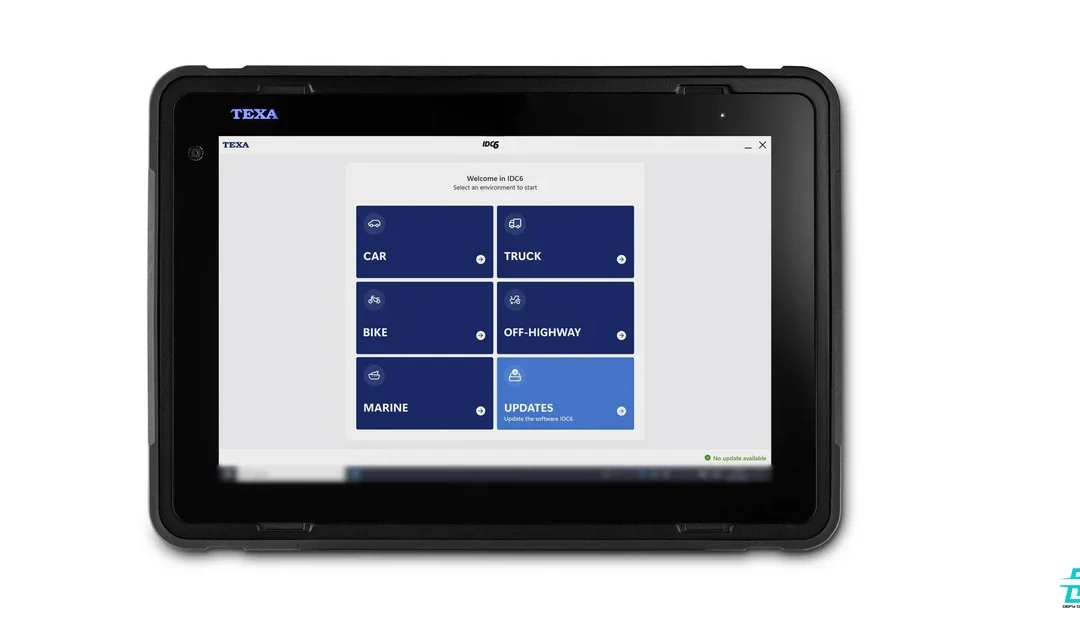
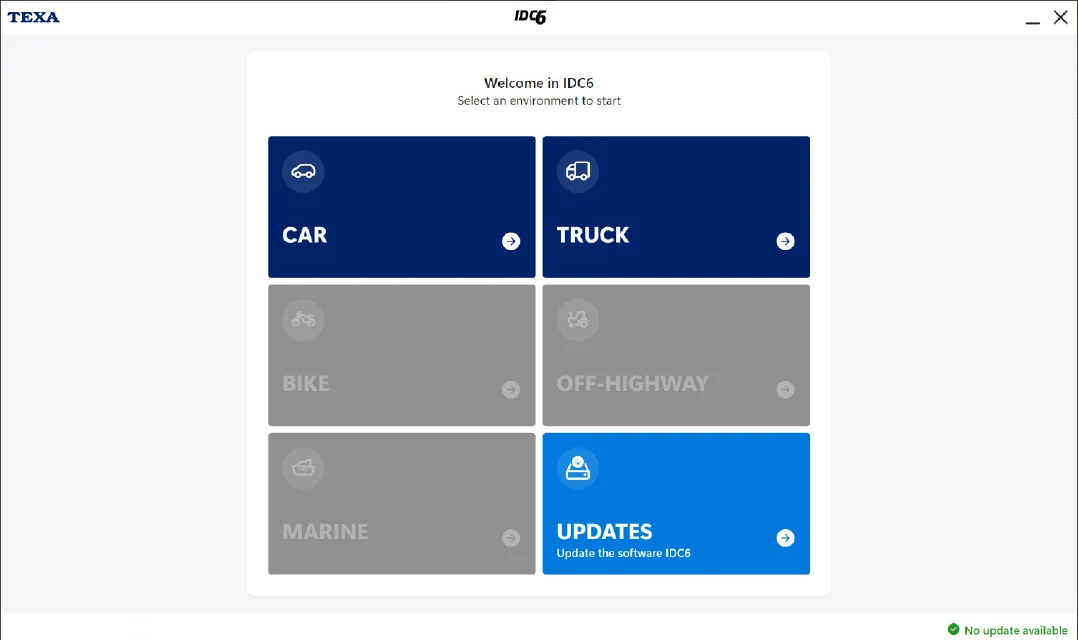
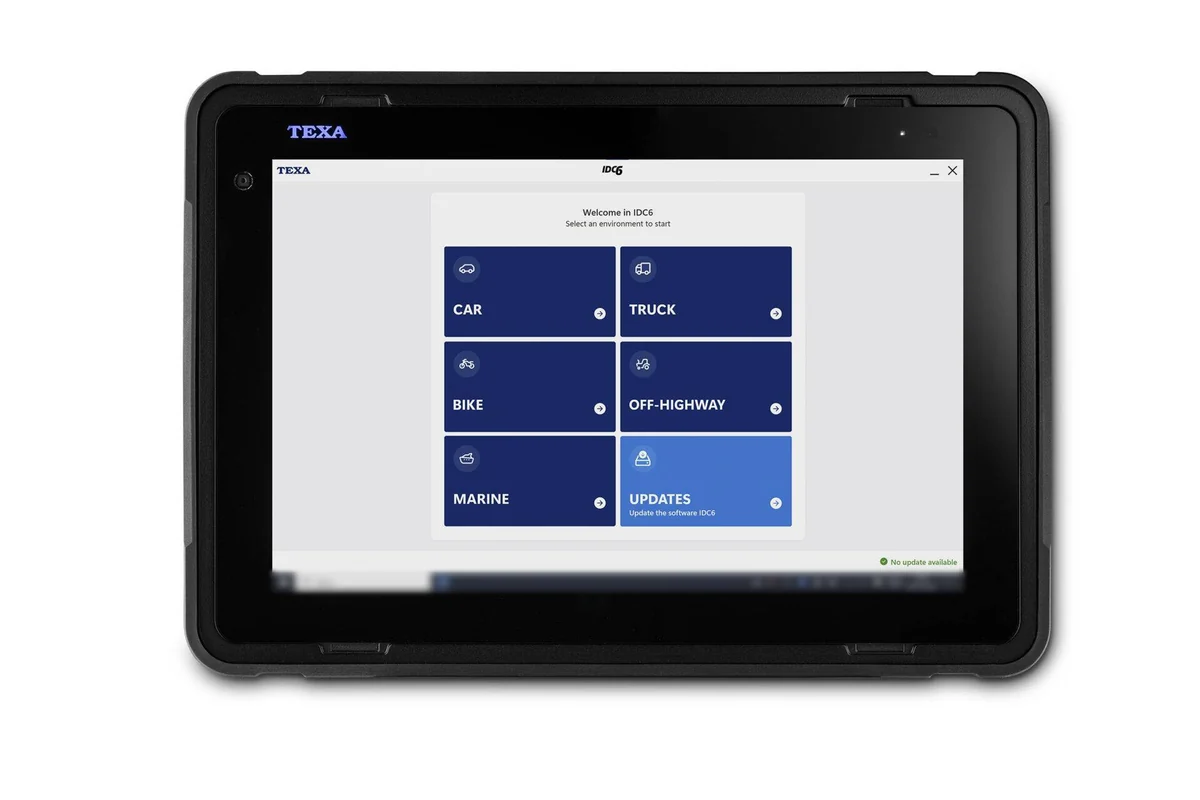
Every TEXA diagnostic package runs on IDC6. The opening screen lets you choose an industry, identify the vehicle (by VIN where supported) and go straight to self-diagnosis, maintenance service, special functions, wiring diagrams or technical data.
AI Global Search and AI Intelligent Diagnosis
IDC6 includes two AI functions. AI Global Search lets you query TEXA’s databases about a specific problem on a given vehicle. AI Intelligent Diagnosis draws on repair solutions defined and archived by TEXA’s call center to help find the fix for a fault. Source: TEXA USA, IDC6 software.
Bi-directional tests, coding and service functions
IDC6 goes beyond reading codes. Depending on the vehicle and license, you can run activations, adaptations, injector coding, service resets, DPF regenerations and other special functions from the same workflow.
Wiring diagrams and technical data
Interactive wiring diagrams, technical sheets and guided diagnosis sit inside IDC6, so a tech can check a circuit while a test is running.
What’s new in IDC6 for 2026
TEXA releases software updates for each industry throughout the year. We cover each release on our blog; find the latest in our IDC6 software articles. Recent highlights:
OHW 2026.20: updates 23 off-highway brands, including John Deere, Case IH and New Holland, and adds 11 dashboards, 14 wiring diagrams and 27 technical sheets. Read the OHW 2026.20 update.
Marine 2026.05: adds complete diagnosis for 19 HIDEA engines, from the HDEF 9.9 to the HDEF 200 FE-T, plus new special settings for Yamaha Marine. Read the Marine 2026.05 update.
Truck 2026.20: updates 38 truck brands and 9 North America heavy duty brands, with Cummins, PACCAR EAS 4 and Detroit PowerShift 5 updates and 19 new wiring diagrams. Read the Truck 2026.20 update.
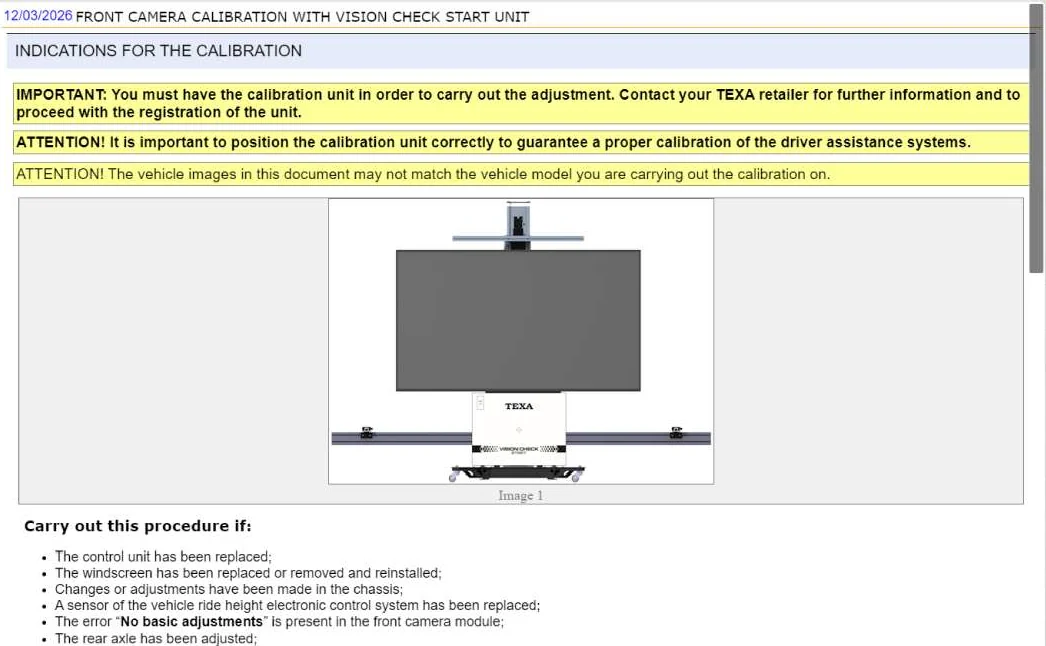
Car 2026.09: adds VISION CHECK START ADAS calibration support, further AI Global Search development, new Hyundai TGS3 dashboards and new systems across 34 car brands.
Automotive diagnostics
The IDC6 Car license covers domestic, Asian and European makes, including Ford, GM, Chrysler, Toyota, Honda, Nissan, Hyundai, Kia, Mercedes-Benz, BMW, Volkswagen, Audi and Volvo.
Manufacturer-level diagnostics: go past generic OBD-II codes into individual control units.
Bi-directional tests: fuel pump, cooling fans, throttle body relearn and more.
Coding and adaptations: injector coding and other procedures where supported.
Service functions: oil and service resets, ABS functions and key programming where supported.
Every Defy Diagnostics diagnostic package includes ADAS calibration in the IDC6 software at no added cost, so your shop can perform dynamic calibrations today. For static calibrations, the TEXA RCCS3 displays targets on a 75-inch 4K monitor, and new targets arrive through software updates. Some models still use a physical target.
An RCCS3 kit with LCN starts at $20,178 plus shipping and tax.
A fully loaded advanced RCCS3 kit with in-shop training comes in under $50,000.
Through December 31, 2026, every RCCS3 includes free in-shop setup and hands-on training from a factory TEXA rep.
Supercars bring proprietary control units, secure gateways and hybrid high-voltage systems. IDC6 Car with supercar coverage lets multi-brand shops handle routine exotic service in the same workflow they use every day. Check model coverage in the IDC6 supercar coverage list (PDF), and call us to confirm a specific VIN before you quote the job.
Heavy-duty truck diagnostics
IDC6 Truck covers North American and global truck brands, including Freightliner, International, Volvo, Mack, Kenworth and Peterbilt, along with engines and systems from Cummins, Detroit and PACCAR. Typical work includes DPF regenerations, aftertreatment tests, parameter changes and wiring diagrams. Shop heavy-duty diagnostic kits or see TEXA USA Truck.
The TEXA CCS2 Truck calibrates radar and camera systems on commercial vehicles. TEXA USA details: CCS2 Dynamics.
Off-highway and construction diagnostics
IDC6 OHW covers construction and agricultural equipment, including Caterpillar, John Deere, Case IH, New Holland and engines such as Kubota. Animated dashboards show fuel, air and aftertreatment systems with live values. Shop off-highway kits or see TEXA USA Off-Highway.
Marine diagnostics
IDC6 Marine covers outboard, inboard and sterndrive engines, including Mercury, Yamaha, Volvo Penta and, with the 2026.05 update, HIDEA. Guided diagnosis, live parameters and wiring diagrams help marine shops cut down on factory tools. Read why TEXA works for marine applications or see TEXA USA Marine.
Powersports diagnostics
IDC6 Bike covers motorcycles, ATVs, side-by-sides and other powersports vehicles, including Harley-Davidson, Ducati and Can-Am. Self-diagnosis, activations, wiring diagrams and AI fault information are all available. Shop powersports kits or see TEXA USA Bike.
TEXA hardware: tablets and VCIs
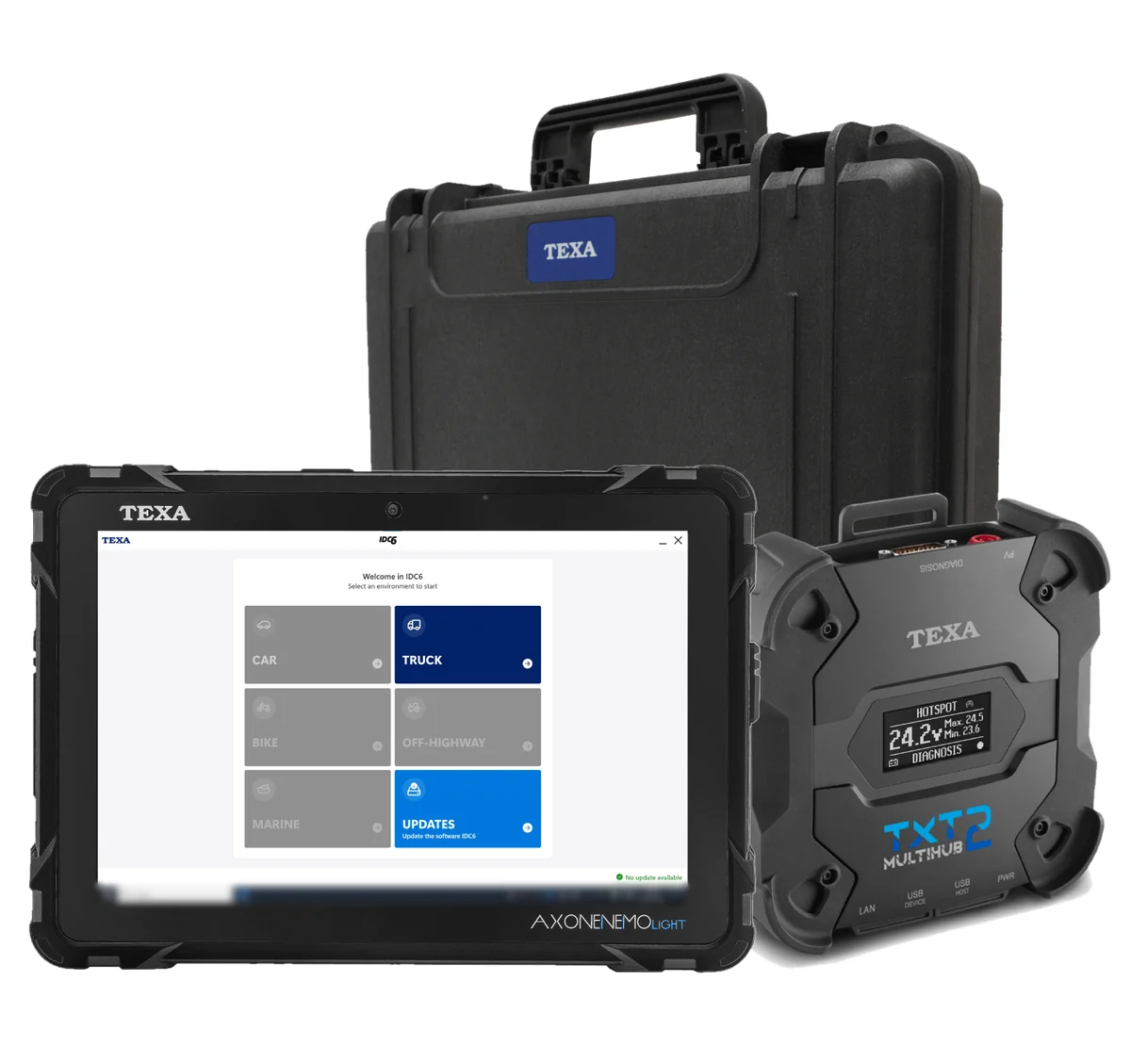
Every TEXA diagnostic package pairs IDC6 with an Axone tablet and a Navigator VCI, and every diagnostic package includes a rugged case.
All 5 TEXA licenses (car, truck, OHW, bike and marine), including the supercar add-on
13.3-inch 2560×1600 Gorilla Glass screen, Intel Core i5, 16 GB RAM, dual-channel Wi-Fi, Bluetooth 5.1, two 8 MP cameras, magnesium case
High-volume and fleet shops
Which VCI do you need?
Navigator Nano S2: car and supercar.
Navigator TXB2: marine and bike.
Navigator TXT Multihub 2: all licenses (car, truck, OHW, bike and marine). Connects by Wi-Fi, Bluetooth, USB and DoIP, supports CAN FD and secure gateway access, and is IP53 rated. TEXA details: Navigator TXT Multihub 2.
Secure gateway access
Many newer vehicles lock diagnostic access behind a secure gateway module. TEXA supports authorized access for supported makes. See TEXA USA secure gateway for details.
TEXPACK renewals and warranty
TEXPACK is the yearly update that keeps each license current with new vehicles, systems and functions, and it is required. Current renewal pricing:
Car TEXPACK: $1,295 per year.
Truck TEXPACK: $995 per year.
Deluxe Fleet TEXPACK: $2,595 per year for the Deluxe Fleet package (Car, Truck and OHW licenses), a savings over buying the three TEXPACKs separately.
ADAS: adds no extra cost to your TEXPACK.
Schools: get free TEXPACKs.
If a TEXPACK lapses, the software keeps working on the coverage you had at your last update, but you will not receive new coverage or functions.
Warranty: every TEXA product carries a 1-year parts and labor warranty. Tablets and VCIs are eligible for a warranty extension each year they stay updated. See our warranty page.
Setup, activation, support and training
Setup and activation: we help with setup and activation, and support you through it.
Support: Active TEXA users get free remote support from Dave, 9 to 5 ET, plus unlimited remote training. See our TEXA support upgrade page.
Frequently asked questions about TEXA diagnostic tools
Do I need separate hardware for each industry?
No. IDC6 Car, Truck, OHW, Marine and Bike licenses run on Axone tablets. The Nemo Light can run any TEXA license with up to 2 installed at once, the Nemo Plus can run any TEXA license with up to 3 installed at once, and the Axone Voice holds all 5, including the supercar add-on. Your VCI must match your licenses: the Navigator TXT Multihub 2 works with all of them.
Is TEXPACK required?
Yes. TEXPACK keeps each license current. Renewals are $1,295 per year for Car, $995 per year for Truck and $2,595 per year for the Deluxe Fleet package (Car, Truck and OHW). ADAS adds no extra cost.
What happens if my TEXPACK lapses?
The software keeps working on the coverage you had at your last update, but you will not get new coverage or functions, and your tablet and VCI lose eligibility for the yearly warranty extension.
What warranty comes with TEXA?
Every TEXA product has a 1-year parts and labor warranty. Tablets and VCIs are eligible for a warranty extension each year they stay updated.
What is included in a TEXA diagnostic package?
An Axone tablet, a Navigator VCI, IDC6 license(s) for your chosen industries and a rugged case.
Who sets up my kit?
We help with setup and activation and support you through it. Active TEXA users get free remote support from Dave, 9 to 5 ET, plus unlimited remote training.
Is iSupport included?
iSupport is available only to TEXAinfo subscribers.
Do schools pay for TEXPACKs?
No. Schools get free TEXPACKs.
Can I add more coverage later?
Yes. You can start with one license and add others later, within your tablet’s license limit.
One platform for every bay
Whether you service an F-150, a Cascadia, an excavator, a Volvo Penta diesel or a Harley-Davidson, IDC6 puts the diagnostics for all of them on one tablet. Call 864-803-3744 or contact us to match a TEXA package to the vehicles in your bays.