
Which platform protects your uptime, margins, and reputation over the next 5+ years? We break down coverage, capabilities, pricing, and real-world ownership—without the fluff.
Quick take: Autel’s low upfront cost is attractive for basic automotive work. TEXA is built for pros—deeper OEM-level functions, multi-industry coverage (car, truck, OHW, marine, powersports), and predictable ownership with U.S.-backed support.
In this guide: coverage & capability, cost of ownership, pros/cons, ADAS/EV insights, and a buyer’s checklist.
Why this comparison matters
Picture a full board, a comeback risk, and a customer who can’t be without their vehicle. When minutes matter, your scanner either confirms your diagnosis—or becomes the problem. That’s the real-world choice between Autel and TEXA. On paper both can scan codes, run tests, and support ADAS. In practice, differences in stability, depth, and long-term costs show up fast.
Below, we’ll map the journey from problem to solution: first coverage (what you can really do), then total cost over 3–5 years, then practical pros/cons, and finally advanced topics—ADAS frames, EVs, protocols like DOIP/CAN-FD, and how to future-proof your shop.
Coverage that actually counts (not just brochure bullets)
Autel shines as a value play for passenger cars—especially domestic and Asian lines. For many general repair shops, that’s “good enough”… until you need deeper routines, parameter programming, or you take on fleets, European cars, or specialty work.
TEXA’s multi-industry backbone
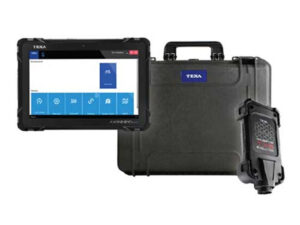
- All-in coverage: Automotive, Heavy-Duty Truck, Off-Highway/Construction, Marine, and Powersports under one platform (IDC6 + Multihub 2).
- OEM-level depth: Advanced routines, calibrations, bi-directional tests, and parameter changes that stick.
- Modern protocols: Ready for CAN-FD and DoIP, with hardware built to grow with your bay—not force a refresh every 2–3 years.
Where Autel hits limits
- Industry gaps: Heavy-duty, OHW, marine, and powersports are limited or require separate ecosystems.
- Depth vs. surface: Coverage screens can look broad, but key routines/parameters may be missing on late models.
- Support model: When something fails mid-job, community forums and overseas RMA queues aren’t a plan.
The real cost of ownership (3–5 year view)
Budget tools are inexpensive to start and expensive to own. Professional tools are the opposite. That’s the heart of TEXA vs Autel.
| Factor | TEXA | Autel |
|---|---|---|
| Upfront Investment | Higher (pro-grade tablet + Multihub + IDC6) | Lower (Android tablet form factors) |
| Annual Renewal | Predictable, single subscription per package | Per-unit renewals; skipping often cripples features |
| Hardware Life | Long lifecycle future-proof protocols | Shorter lifecycle forced refresh common |
| Multi-Industry Expansion | Built-in (Car/Truck/OHW/Marine/PowerSport) | Requires other tools (adds cost/complexity) |
| Support & Warranty | U.S.-based support + lifetime warranty (active sub) | Mixed support + overseas RMA delays |
Rule of thumb: If you keep tools 4–6 years and your work spans more than basic automotive, TEXA’s total cost of ownership (TCO) is typically lower than cycling through consumer-style tablets plus add-ons.
Pros & cons in real bays (technician-first view)
TEXA — built for professionals
- Pros: Multi-industry depth; stable workflows; parameter programming that “takes”; strong U.S. support; lifetime warranty with active subscription; hardware ready for CAN-FD/DoIP.
- Cons: Higher upfront; IDC6 has more muscle → a short learning curve (we provide onboarding).
Autel — value for basic automotive
- Pros: Low entry price; broad passenger-car coverage; attractive UI; widely available.
- Cons: Costly renewals; stability complaints on complex routines; weaker specialty coverage (truck/OHW/marine/PS); hardware obsolescence pushes upgrades.
If your shop roadmap includes fleets, European performance, marine, or heavy equipment—even at 10–20% of your work—TEXA prevents a second purchase later.
Advanced insights: ADAS, EVs, and future-proof protocols
ADAS calibration
Autel popularized large calibration frames and target kits—great for marketing, but real coverage depends on software depth and reliable routines. TEXA pairs IDC6 with RCCS3 ADAS systems, bringing OEM-level procedures and a stable update cadence that keep bays moving.
EV diagnostics
Battery state-of-health visuals are helpful, but without consistent OEM-level routines they can mislead. TEXA’s EV coverage expands each cycle, and Multihub 2’s modern protocol support ensures today’s investment isn’t tomorrow’s “legacy tablet.”
Protocols & performance
- CAN-FD & DoIP: Supported on TEXA Multihub 2 for newer platforms.
- Workflow UX: IDC6 is designed for repeatable, auditable processes (great for fleets and compliance).
- Scalability: One platform, five industries → simpler training, fewer vendors, lower downtime risk.
Key Takeaways
- Most important: TEXA provides pro-grade depth across all industries with predictable costs.
- Most actionable: If your roadmap includes fleets/ADAS/European/EV, start with TEXA to avoid a second purchase.
- Most surprising: Over 3–5 years, Autel’s renewals and hardware refreshes can meet or exceed TEXA’s TCO.
- Next step: Talk to a Pro to match the right TEXA package to your mix.
FAQs
Q. Is Autel enough for a small general repair shop?
A. Sometimes—if you’re doing basic automotive only and can accept renewal-tied features and shorter hardware lifecycles. If you want stable ADAS/EV growth or occasional European/fleet work, TEXA is a safer long-term platform.
Q. Why do technicians outgrow Autel?
A. As vehicles and customers diversify, gaps appear: missing routines, unreliable parameter changes, limited heavy-duty/OHW/marine support, and rising renewal costs. That’s when shops switch to TEXA.
Q. What does TEXA’s “lifetime warranty” actually mean?
A. With an active software subscription, TEXA hardware remains covered for the life of the product—a major hedge against obsolescence and unexpected replacement costs.
Q. Which TEXA package should I start with?
A. For cars (incl. European & supercar): Axone Voice + Multihub — Car/Supercar Kit. For mixed shops and fleets: Axone Nemo Plus + Multihub — Car Kit. For trucks/OHW expansion, ask us about the Deluxe Fleet Package.
Q. Can I keep Autel for ADAS and add TEXA for diagnostics?
A. You can, but it doubles complexity and costs. Many shops standardize on TEXA for both diagnostics and ADAS to simplify training, updates, and support.
Need a second set of eyes? Every shop mix is different. Talk to a Pro and we’ll map the right TEXA kit to your bays, vehicles, and growth plan.