
It is 5 AM, 20 degrees, and the starter is spinning. The first instinct is to grab the jumper cables. Most of the time, the batteries are not the problem. The fuel has gelled or iced, and the filters cannot pass it.
That scene comes from a recent Construction Equipment article by Jessica Crabtree, a fuel chemist and director of technical services at Power Service Products. Her point is simple: on modern common-rail engines, winter problems are cheaper to prevent than to fix. This checklist pulls her fuel advice together with OEM guidance on diesel exhaust fluid (DEF), so your trucks and equipment are ready before the first hard freeze.
Why winter is harder on modern diesel fuel systems
Older mechanical engines ran around 3,000 psi through 30-micron filters. Per the Construction Equipment article, modern Tier 4 Final and Stage V common-rail systems run pressures over 30,000 psi with clearances under two microns, and they use filters fine enough to trap wax crystals that older systems passed through.
Diesel does not freeze solid like water. As it cools, paraffin wax drops out of solution. The fuel turns hazy at its cloud point, which the article puts at typically 30°F to -10°F depending on the fuel, and then plugs filters at the cold filter plugging point (CFPP).
When a filter plugs, the high-pressure pump is starved. The article explains that this can strip the pump’s lubricating film and score the plungers, and if the system cannot build the rail pressure the ECM needs to fire the injectors, the engine just cranks.
Biodiesel blends and water make it worse
Much of the diesel sold today contains some biodiesel. The U.S. Department of Energy notes that higher biodiesel blends can gel in cold temperatures. The Construction Equipment article adds that biodiesel pulls moisture from the air, and that water settles in the tank and water separator, where it turns to slush and ice at 32°F. Standard petroleum anti-gels will not handle biodiesel fallout, so winter additives must be made for biodiesel blends.
Winter diesel fuel checklist
Work through these items now, while temperatures are still above your fuel’s cloud point.
- Treat fuel before it reaches its cloud point. Anti-gel additives keep wax crystals small enough to pass the filter. They do not fix wax that has already formed. Treat bulk fuel at delivery when possible so the additive mixes in fully.
- Use an additive matched to your fuel. If you run biodiesel blends, use a winter additive formulated for them. Look for a package with a cold flow improver, de-icer and cetane improver.
- Check bulk tanks for water. Use water-finding paste on a gauge stick weekly, and pump water out from the lowest drain point before it reaches the transfer pump pickup.
- Filter at the transfer pump. The article recommends a 10-micron water-absorbing filter on the transfer pump discharge.
- Change primary and secondary filters before winter. Summer sediment in an old filter gives wax crystals a head start.
- Service water separators. Clean the sediment traps, inspect plastic bowls for cracks, and verify the water-in-fuel (WIF) sensor probes are clean and working.
- Top off tanks at the end of the shift. Filling to about 95 percent at shutdown reduces headspace air and overnight condensation.
- Stock the service trucks. Keep an emergency de-icer that reliquefies fuel without stripping lubricity.
Winter DEF checklist
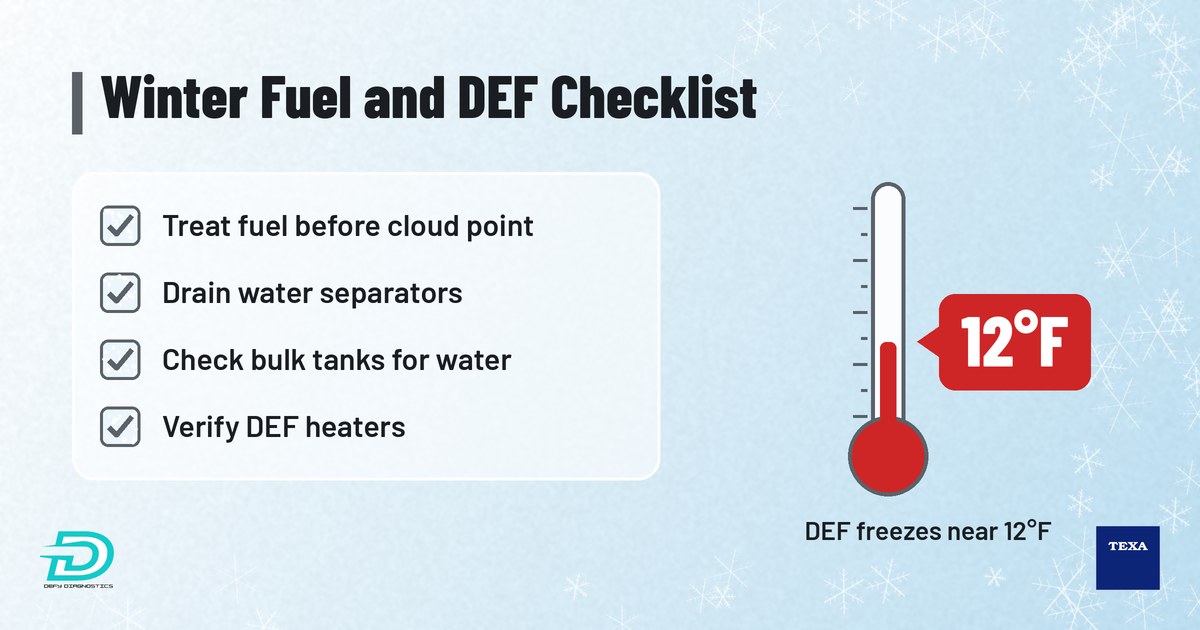
DEF is a solution of urea and deionized water, and it does freeze. A GM service bulletin on DEF, posted by NHTSA, states that DEF freezes at about 12°F (-11°C) and expands when it freezes. That is normal. SCR systems are built for it, with heated tanks and lines that thaw the fluid after start-up.
What causes trouble is the stuff around the freeze. Here is what to check.
- Do not overfill DEF tanks. Tanks are designed with air space for expansion. The same GM bulletin warns that overfilling may not leave room for that expansion when the fluid freezes.
- Do not add a freeze-point improver to DEF. Per the GM bulletin, it alters the DEF mixture and can trigger a poor exhaust fluid quality warning.
- Use certified DEF. The GM bulletin calls for DEF labeled API-certified or ISO 22241.
- Verify tank and line heaters on a cold start. Frozen DEF should thaw after start-up. If a unit throws DEF heater, quality or level codes on cold mornings, check the heater circuits before you condemn the doser or sensors.
- Expect delayed level readings. The GM bulletin notes that a fully frozen tank can take almost an hour after start-up before the system detects a refill, because the level sensor cannot read frozen fluid.
- Store bulk DEF indoors. The GM bulletin says DEF is best stored out of direct sunlight between 12°F and 86°F.
Scan before the first hard freeze
The best time to find a weak heater, a failing water-in-fuel sensor or a marginal fuel pressure reading is on a mild day in the shop, not on the side of a road in January. A pre-winter scan gives you a baseline and catches problems while they are still cheap.
- Pull and record fault codes in the engine and aftertreatment modules, including stored and inactive codes. Our DTC library can help you decode them.
- Check fuel system live data such as fuel and rail pressure while cranking and at idle, compared with the OEM specification.
- Check DEF system parameters such as tank temperature, level and heater status, where the vehicle supports them.
- Run supported tests and regens before winter instead of during it.
- Clean up open aftertreatment issues now. A DPF or SCR problem that limps through fall can become a derate in the cold.
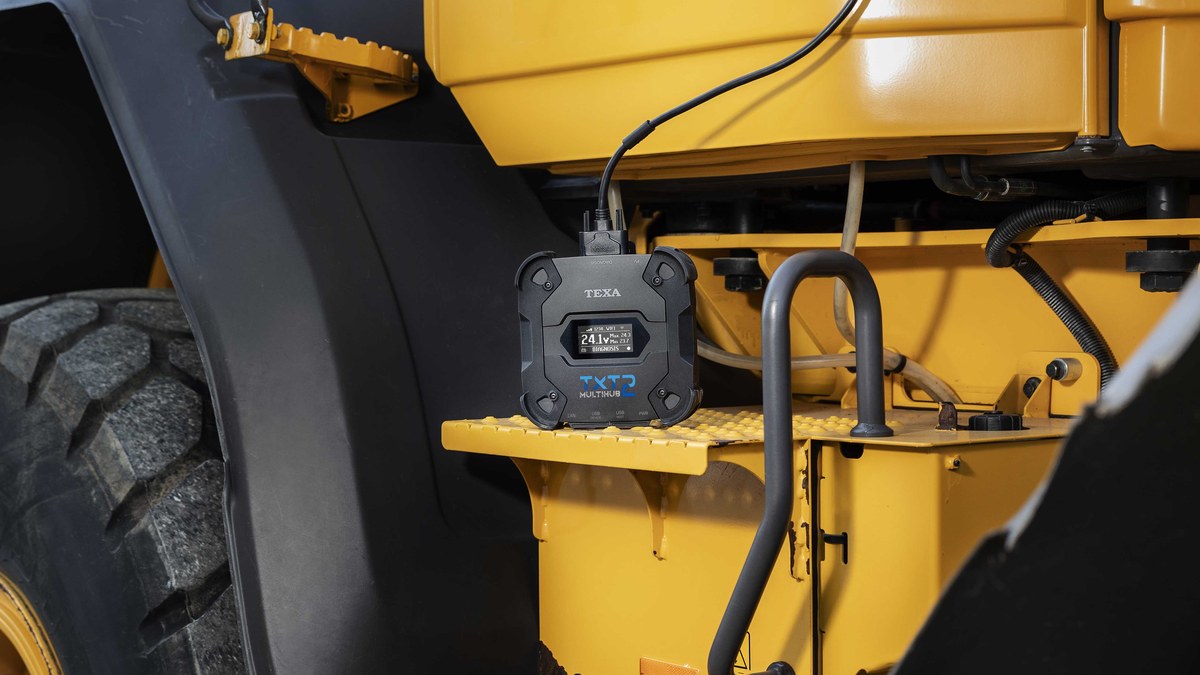
With TEXA IDC6 Truck or Off-Highway software and a TEXA Navigator TXT Multihub 2, you can read fault codes, view live parameters and run bi-directional tests and DPF regens on supported trucks and equipment. Available functions depend on the vehicle and OEM. If you need a wiring check on a heater circuit, our free diesel truck wiring diagrams are a good place to start.

Who should run this checklist
- Fleet maintenance managers with trucks that sit outside overnight.
- Government and municipal fleets getting snowplows and winter equipment ready.
- Independent diesel and off-highway shops that will see no-start calls in the first cold snap.
- Mobile diesel techs who work on jobsites and in yards.
- Technical schools teaching cold-weather service on modern common-rail and SCR systems.
Related reading
Fuel rules have been changing this year too. See our posts on the Texas diesel fuel waiver, dyed diesel on highways and the EPA 2027 emissions rule. For background on U.S. diesel fuel requirements, see the EPA diesel fuel standards. Check the Defy Diagnostics Specials page for current offers on truck and off-highway kits.
Talk to a Diagnostic Expert
Want a pre-winter scan setup for your trucks or equipment? Look at the TEXA AXONE Nemo Plus Truck Kit or the TEXA AXONE Nemo Plus OHW Kit, or call 864-803-3744, Monday through Friday, 9 AM to 5 PM ET. You will talk to a person.
Frequently asked questions
At what temperature does diesel fuel gel?
It depends on the fuel. Diesel starts to cloud as wax forms at its cloud point, typically between 30°F and -10°F, and can plug filters at its cold filter plugging point. Biodiesel blends can gel earlier.
When should I add anti-gel to diesel fuel?
Before the fuel reaches its cloud point, ideally when bulk fuel is delivered. Anti-gel additives do not fix wax that has already formed.
At what temperature does DEF freeze?
DEF freezes at about 12°F (-11°C). This is normal, and SCR systems use heated tanks and lines to thaw it after start-up.
Can I add anything to DEF to keep it from freezing?
No. A freeze-point improver alters the DEF mixture and can trigger a poor fluid quality warning. Use API-certified or ISO 22241 DEF.
Why does my DEF gauge read wrong on cold mornings?
The level sensor cannot read frozen DEF. A fully frozen tank can take almost an hour after start-up before a refill is detected.
What should I scan before winter?
Pull engine and aftertreatment fault codes, check fuel and rail pressure live data, check DEF heater and temperature readings where supported, and clear up open DPF or SCR issues.


