
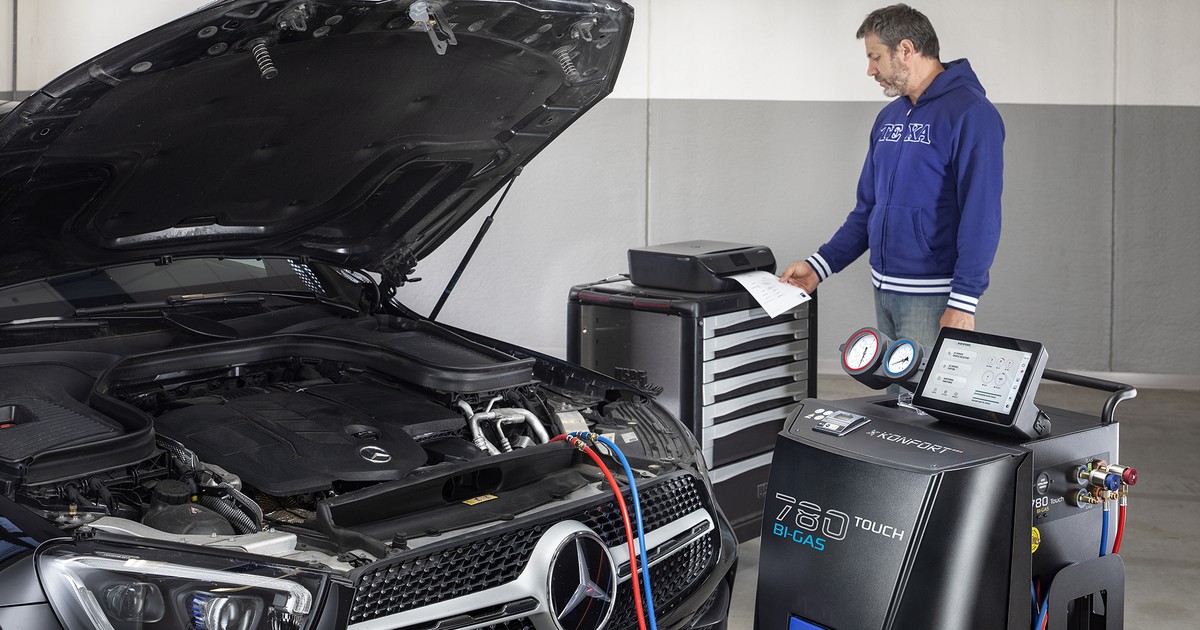
A/C work used to start and end with a set of gauges. Hook up, read the pressures, add refrigerant, and send it.
That approach misses too much on today’s vehicles. R-1234yf needs dedicated equipment. Hybrids and EVs use high-voltage electric compressors. On EVs, the A/C system also helps cool battery packs and electronics, as the ASE Section 609 training manual points out. More of the system is run by sensors and modules.
Here is a practical flow for automotive A/C diagnosis on modern systems, how the leak detection methods compare, and which machine your shop or fleet actually needs.
Why gauges alone fall short
Gauges tell you what the pressure is. They do not tell you why. On a modern system, that gap shows up in a few places:
- Refrigerant type. Gauges cannot confirm what is in the system. A contaminated or mislabeled system can ruin your machine’s refrigerant supply.
- Small leaks. A slow leak can be the whole complaint and still be hard to find with gauges.
- High-voltage compressors. These need non-conductive oil. International’s EV service guidance warns that as little as 1% standard PAG oil can reduce the dielectric properties of approved POE oil and damage the system.
- Electronic control. On many systems, a pressure sensor feeds a control module, and the module decides when the compressor runs. A no-cool complaint can be a data problem, not a refrigerant problem.
A modern A/C diagnostic flow, step by step
1. Start with the scan tool
Before you connect a machine, pull codes and look at live data. Check the A/C pressure sensor reading, compressor request and command, and any HVAC module codes. On hybrids and EVs, follow the OEM procedure to disable high voltage before any A/C service.
2. Identify the refrigerant before recovery
Never recover blind. R-1234yf machines certified to SAE J2843 use an integrated or external identifier, and the refrigerant must read at least 98% pure R-1234yf before the machine allows recovery, per the ASE 609 manual. Contaminated refrigerant goes to a reclaimer, not into your machine.
3. Recover, weigh, evacuate, and watch for vacuum decay
Compare what you recovered to the vehicle’s specified charge. A big shortfall confirms a leak before you start hunting. Measure the recovered oil so you can replace the right amount.
Then evacuate. J2843 machines hold the system under vacuum and monitor for decay. If the vacuum decays too much, the machine flags a leak and will not let the recharge continue.
4. Find the leak
Pick the method that matches the leak. More on that below.
5. Repair, recharge by weight, and verify
Recharge to the specified weight, not to a pressure reading. Then go back to the scan tool and confirm the sensor reading, compressor command, and vent temperature all make sense.
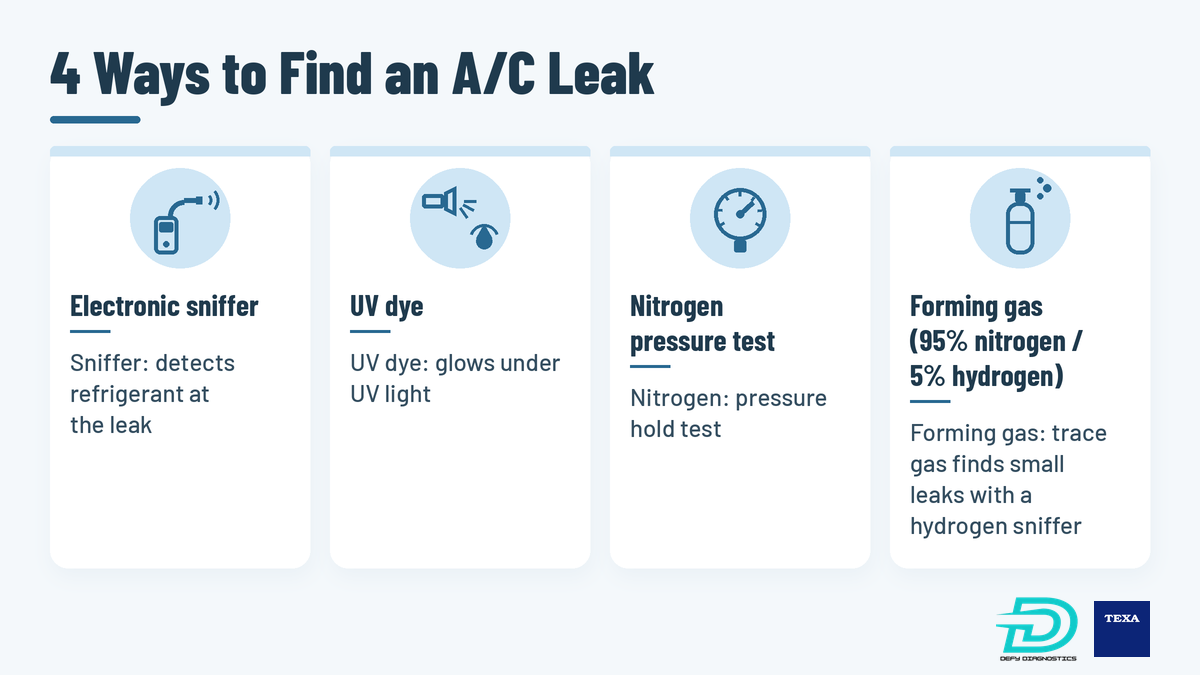
A/C leak detection methods compared
Every method has a place. The trick is knowing what each one can and cannot tell you.
| Method | What it tells you | Limits |
|---|---|---|
| Electronic refrigerant sniffer | Locates refrigerant escaping from a charged system | Needs refrigerant in the system; underhood chemicals can cause false triggers |
| UV dye | Shows where dye has collected at a leak | The system has to run long enough for dye to reach the leak |
| Nitrogen pressure test | Confirms whether the system holds pressure | Does not pinpoint where the leak is |
| Forming gas (95% N2 / 5% H2) | Locates very small leaks using a hydrogen sniffer | Needs a forming gas supply, regulator, and hydrogen detector |
Electronic sniffers
Detectors for R-134a are certified to SAE J2791, and R-1234yf detectors to SAE J2913. Both standards include a 0.15 oz (4 g) per year sensitivity scale. SAE J1628 says to test with the system off, at least 50 psi static pressure, and the probe moving no faster than 3 inches per second.
UV dye
SAE J2297 covers dye stability and compatibility for R-134a and R-1234yf systems. Dye circulates with the refrigerant and oil and collects at the leak point. It works well on leaks you can see, but it is not instant.
Nitrogen pressure test
Pressurizing with dry nitrogen is a solid pass or fail check. As TEXA notes, pure nitrogen can show you have a leak but does not show where it is.
Forming gas trace testing
Forming gas is 95% nitrogen and 5% hydrogen. Hydrogen is the lightest element, and at this ratio the mixture is classified as non-flammable. Because hydrogen molecules are so small, they escape through leaks that refrigerant-based methods can miss, and a hydrogen sniffer picks them up.
After recovery, you fill the system with forming gas at the desired pressure and scan the joints. Hydrogen rises, so keep the probe above the area you are testing. No dye goes into the system, and no refrigerant is lost while you search. TEXA says the method meets Daimler AG’s requirements for gas detectors.
Use scan data, not just pressures
TEXA IDC6 software reads live engineering parameters from vehicle control units. Its Dashboards display those parameters with graphics of the system and its operating logic. Coverage varies by vehicle, so check your make and model.
Start with three checks:
- Pressure sensor vs. gauge. Compare the sensor value in IDC6 with the machine’s pressure reading. If they disagree, suspect the sensor or its circuit.
- Compressor command. See whether the module is requesting the compressor and why it might be holding it off.
- HVAC module codes. Blend door, temperature sensor, and communication faults can all look like a refrigerant problem.
Our Light Car Kit runs IDC6 for passenger vehicles.
New refrigerant blends: R-456A and R-444A
At the MEMA Technology Conference on October 6, Orbia Fluor and Energy Materials presented two new blends. It describes R-456A as a direct replacement for R-134a and R-444A as a low-cost replacement for R-1234yf.
The regulatory status matters. EPA has proposed listing both blends as acceptable, subject to use conditions, for certain retrofit vehicle A/C uses under SNAP Proposed Rule 27, with a supplemental proposal in April 2026. As of October 9, 2026, that rule is not final.
For shops, the takeaway is simple. Expect to see more refrigerant types and retrofit labels. Identify before every recovery, and confirm both the vehicle and your equipment are approved for a refrigerant before you service it.
Which A/C machine you really need
Section 609 also applies here. Anyone servicing vehicle A/C for pay must be trained and certified by an EPA-approved program. With that covered, match the machine to your work.
Light-duty shops
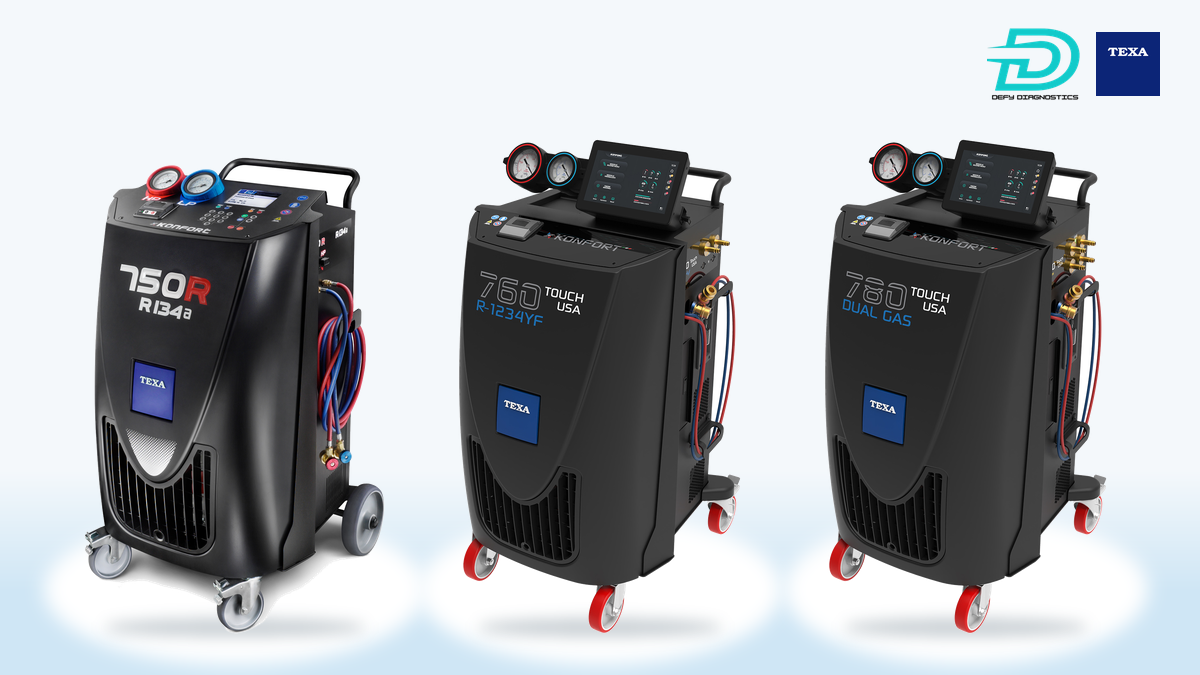
The TEXA Konfort 760 R1234YF handles R-1234yf with fully automatic service, automatic refrigerant identification, automatic leak detection, electronic scales for refrigerant and oil, hybrid compatibility, a two-stage vacuum pump, and over 95% recovery efficiency. See how it stacks up in our Konfort 760 vs. Robinair AC1234-9 comparison.
Still seeing mostly older R-134a vehicles? The TEXA Konfort 750R is fully automatic, with an electronic scale accurate to +/- 5 grams, and conforms to SAE J2099 and J2788.
Mixed shops: dual-gas
If you see both refrigerants every week, the TEXA Konfort 780 Touch runs R-134a and R-1234yf on two separate circuits with two 20 lb tanks. It has a refrigerant identifier, automatic leak detection, over 97% recovery efficiency, and flushing for refrigerant and oil changes. The forming gas kit is listed as an option. Our Konfort 780 vs. Snap-on Polartek breakdown covers changeover time and cost.
Heavy-duty and government fleets
Fleets rarely service just one vehicle type. Pickups and vans sit next to trucks and buses, so a dual-gas machine covers more of the lot. Check the underhood label on every unit.
Electric buses add another wrinkle. International’s service guidance for its electric school buses and eMV trucks recommends using a dedicated A/C machine for EV systems that use POE or PVE oil where possible, plus a dedicated oil injector for each oil type. For long reach on trucks and buses, add the Konfort 3-meter extension hose kit.
Add the forming gas leak detection kit
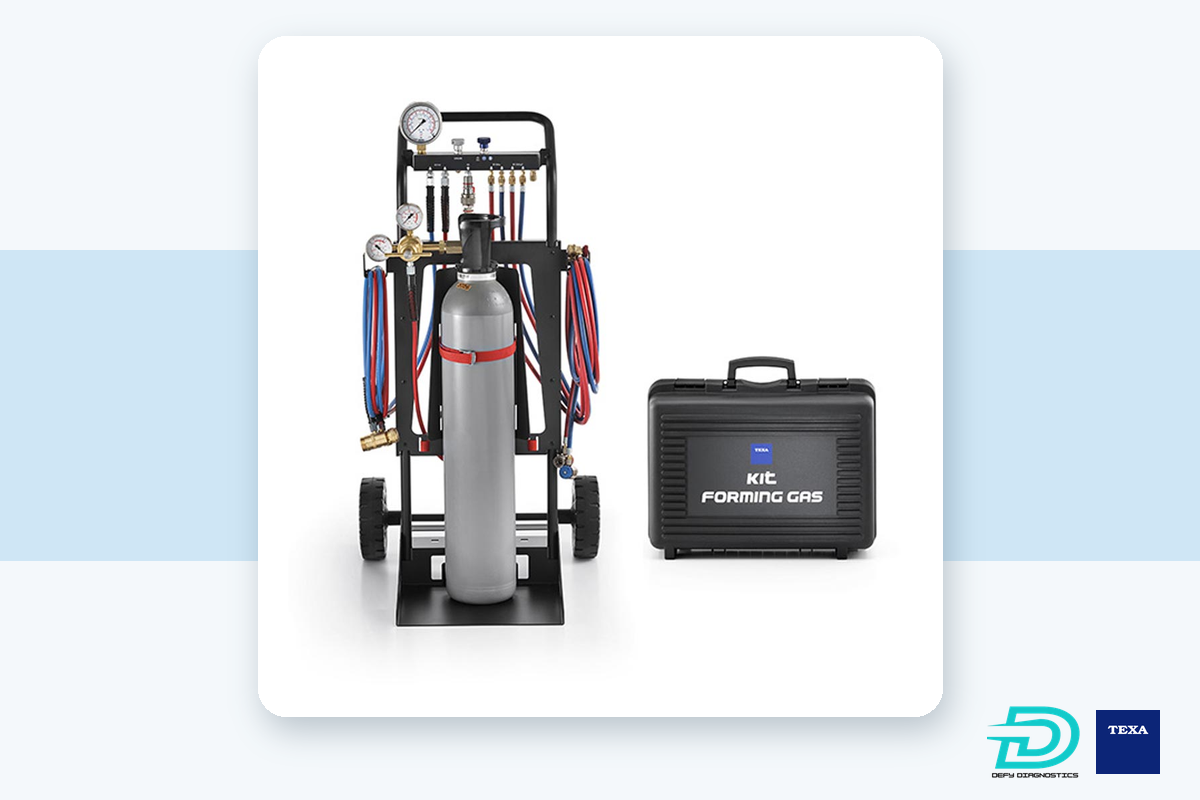
A leak you miss is a vehicle that comes back. Our TEXA Forming Gas Leak Detection Kit is $3,340 and is built for R-134a and R-1234yf systems. It includes:
- Forming gas regulator with pressure gauge
- Forming gas cart
- Hose kit and fittings
- Instructions for use with the TEXA sniffer or other compatible hydrogen detectors
The gas cylinder is not included. You will also need a hydrogen detector such as the TEXA H2 Detect, sold separately. Want the full background? Read why the forming gas kit belongs in your shop.
Quick answers
Can you diagnose a modern A/C system with gauges alone?
Not reliably. Gauges show pressure, but they cannot identify the refrigerant, find a small leak, or show what the control module is commanding. Pair them with an identifier, a leak detection method, and scan data.
What is forming gas, and is it safe for A/C leak detection?
Forming gas is 95% nitrogen and 5% hydrogen. The blend is classified as non-flammable. A hydrogen sniffer finds the hydrogen escaping from even very small leaks.
Do I need a refrigerant identifier?
Yes. Equipment certified to SAE J2843 must confirm R-1234yf is at least 98% pure before it will recover. Identifying first also protects your machine and refrigerant supply from contamination.
Are R-456A and R-444A approved for vehicle A/C?
Not yet. EPA has proposed listing both as acceptable, subject to use conditions, for certain retrofit uses. As of October 9, 2026, that rule is not final.
Build the right A/C setup for your bays
A Konfort machine handles recovery, evacuation, and recharge by weight. The forming gas kit finds the leaks that cause comebacks. IDC6 shows you what the modules are doing. Together, they replace guesswork with answers.
Check our Specials page for current offers, or let us help you pick the right combination for your shop or fleet.
Talk to a Diagnostic Expert or Request Your Custom Kit Quote.


