Supercapacitor jump starters are getting attention this month. leagend recently announced that its JS300 PRO series reached its Kickstarter funding goal. It is a permanently installed starting system that uses supercapacitors instead of a built-in lithium battery. More people looking at battery-free starting is a good thing.
The technology itself is not new. Supercapacitor boosters are proven, and shops and service fleets have relied on them for years. Dave Caron, who runs Defy Diagnostics, has sold GYS supercapacitor boosters for years, first at a previous company and now here. Here is why the technology works, why winter is when it matters most, and what we carry.
What a supercapacitor jump starter does differently
A lithium jump pack stores energy in a chemical battery. It slowly loses charge on the shelf, it has to be kept charged, and it wears out with age and cycles. A supercapacitor stores energy electrostatically. It charges in seconds to minutes, delivers a very high burst of current, and handles a very large number of charge and discharge cycles.
The tradeoff is that a supercapacitor does not hold its charge for long. GYS states plainly that you do not need to keep a GYSCAP on charge, and that if you charge it a day or more ahead it may be partly or fully discharged when you get to the job. The point is that it does not need to be. You top it up right before the start.
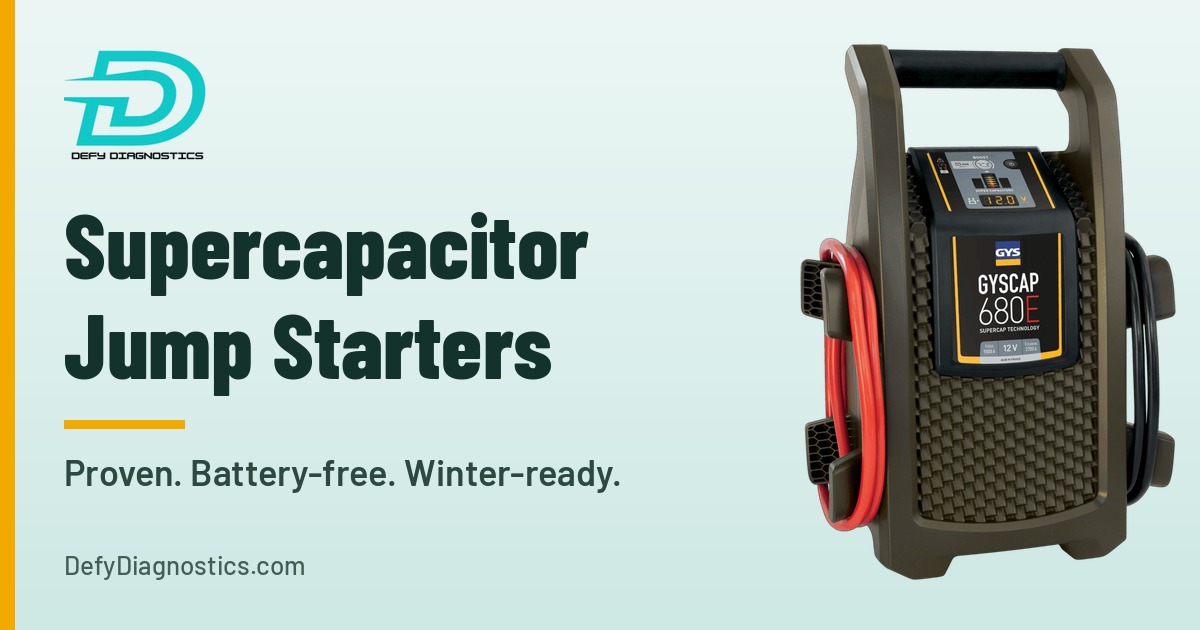
The GYSCAP 680E batteryless booster

The GYS GYSCAP 680E ($1,495) is a 12V booster with no internal battery. Per the GYS datasheet, it is built around five supercapacitors and delivers:
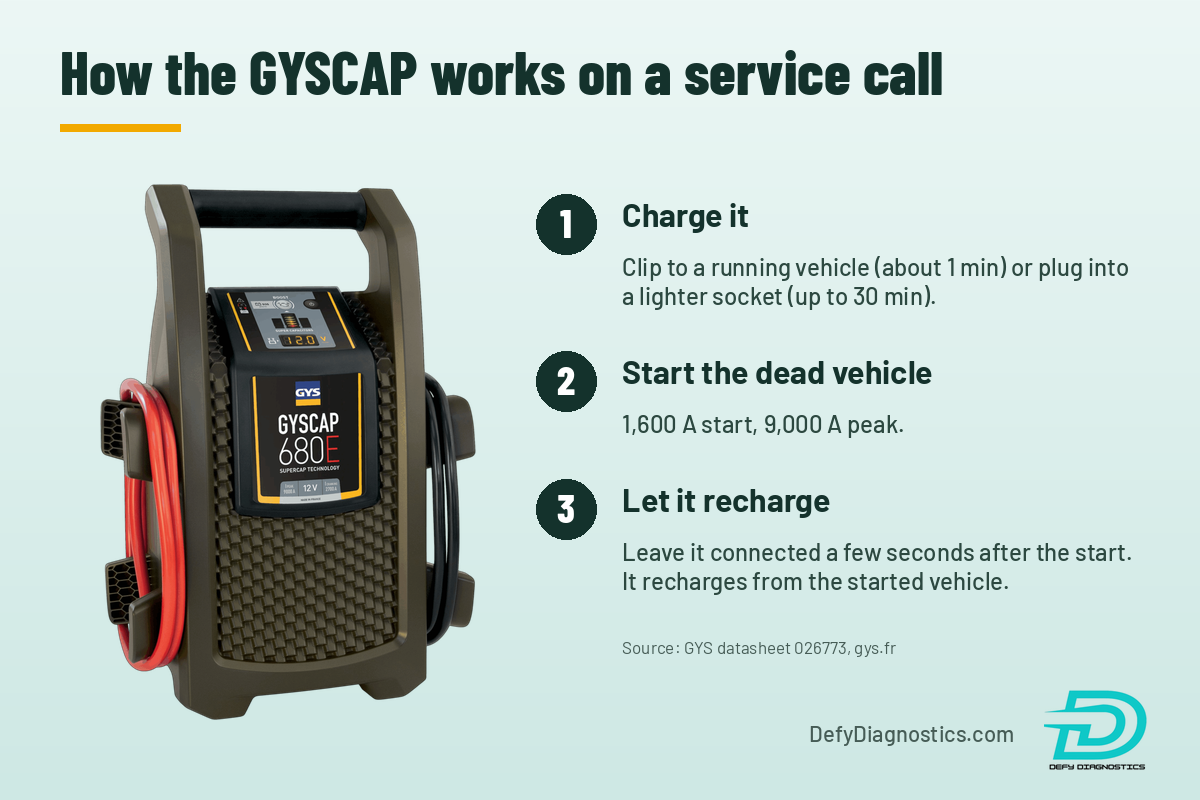
- 1,600 A starting current and 9,000 A peak for 12V gas and diesel vehicles.
- 1,000,000 charge and discharge cycles, as rated by GYS for the supercapacitors.
- Recharge in about 1 minute from a running vehicle through the clamps, or up to 30 minutes from a 12V lighter socket. It can also charge from the mains with a GYSFLASH 4A charger and the optional accessory.
- Two start modes: automatic, and a forced SOS mode for deeply discharged batteries.
- Protection against reversed polarity, shorted clamps and deep discharge, plus a display that shows battery and alternator voltage.
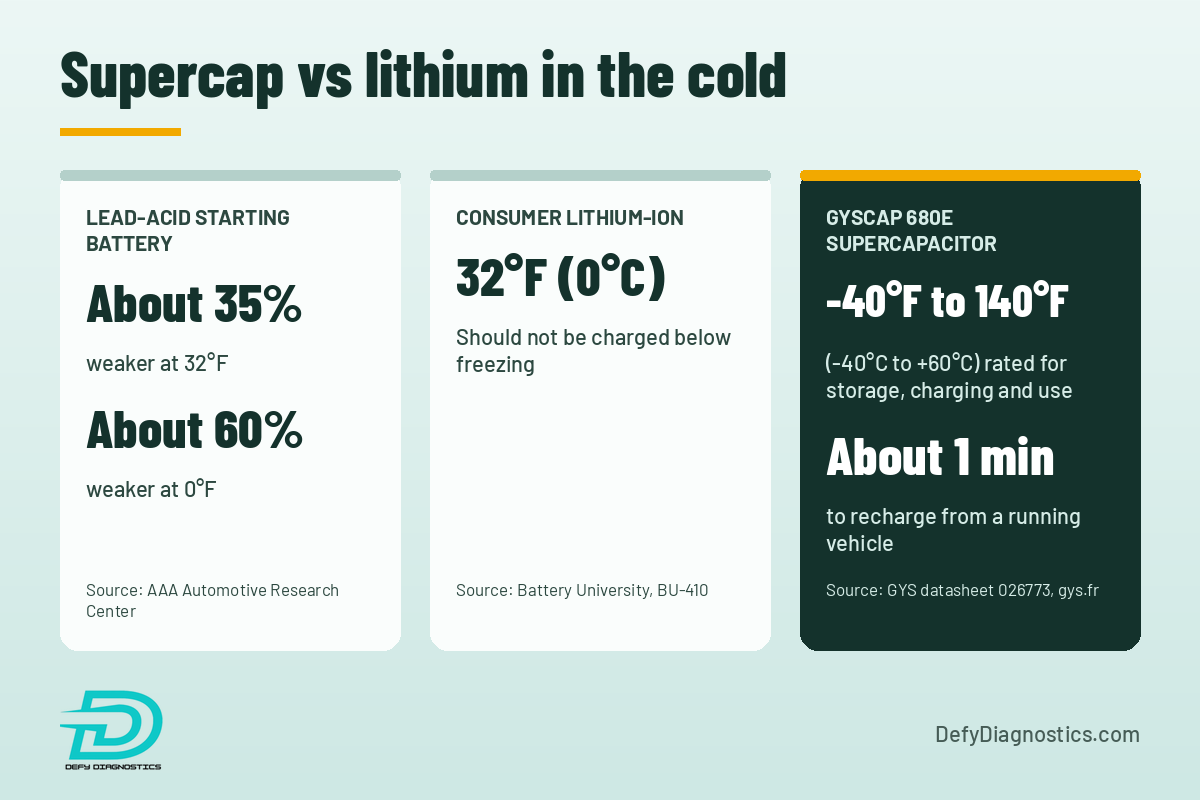
- Rated from -40°C to +60°C (-40°F to 140°F) for storage, charging and use.
With no battery inside, there is nothing to replace and no maintenance schedule. A cycle rating that high means wear is not the thing that limits the unit.
Why winter is when it earns its keep
Cold is hard on batteries. The AAA Automotive Research Center reports that a car battery loses about 35 percent of its strength at 32°F and about 60 percent at 0°F, and cold engines can need up to twice the current to start. That is when the no-start calls pile up.
Lithium jump packs have their own cold problem. According to Battery University, consumer-grade lithium-ion cells should not be charged below freezing, 32°F (0°C), because it can permanently damage them. A pack that rides in an unheated truck all night may not be ready to charge when you need it.
Supercapacitors avoid that problem. The 680E is rated down to -40°C (-40°F) for charging and use, so a unit that sat in a cold truck can be charged from the vehicle and put to work. If your no-starts turn out to be fuel and not batteries, see our winter diesel fuel and DEF checklist.
Built for service trucks and mobile techs
A lithium jump pack on a service truck has to go back on a charger, or it is low when the call comes in. The GYSCAP works differently. It can ride in the truck until you need it. When you get to the job, clip it to a running vehicle for about a minute, or use the lighter socket, then make the start. After the start, leave it connected for a few seconds and it recharges from the vehicle you just started, ready for the next one.
There is no “did anyone plug in the jump pack” conversation, and no lithium pack to replace every few seasons.
The other half of winter battery care
GYSFLASH S 4.12 smart charger and maintainer

Starting a dead battery is one job. Keeping batteries healthy through the winter is the other. The GYSFLASH S 4.12 ($115) is a 12V, 4A smart charger with a 120V North American plug. Per GYS, it has a seven-step charging and maintenance cycle, SOS recovery for deeply discharged batteries above 2V, and a winter mode for charging below 5°C (41°F). It can stay connected indefinitely during winter storage. It is sized for 12V lead-acid batteries from 1.2 to 90 Ah and maintains batteries up to 130 Ah, so it fits pickups, service vehicles, powersports and equipment kept in storage.
GYSFLASH 121.12 CNT battery support unit

If you are running diagnostics, programming or calibrations all winter, stable voltage matters. A sagging battery can interrupt a long procedure. The GYSFLASH 121.12 CNT ($1,945) is built for that. GYS says it holds a 12V lead or lithium (LFP) battery at a stabilized voltage during diagnostics. Its Diag+ mode supports up to 120 A on a 230V supply, or 100 A on a 110V supply. It also has charge, showroom and tester modes, and handles 12V batteries from 20 to 1,500 Ah.
See the full GYS battery support lineup for more options.
Who this is for
- Fleet maintenance managers with trucks and equipment parked outside overnight.
- Government and municipal fleets getting plows and winter equipment ready.
- Independent shops that see the first cold-snap wave of no-starts.
- Mobile diesel techs who need a booster that is ready when the call comes in.
Related reading
Getting ready for winter? Start with our winter diesel fuel and DEF checklist. For electrical troubleshooting, see our free diesel truck wiring diagrams and our DTC code library. Current offers are on the Specials page.
The bottom line
Supercapacitor starting is not a novelty. It is proven technology, and winter is when it pays for itself. If your fleet or shop is heading into cold season with aging batteries, let’s sort it out before the first freeze.
Talk to a Diagnostic Expert
Questions about the GYSCAP 680E or the right charger for your fleet? Call 864-803-3744 or email Dave@DefyDiagnostics.com. You will talk to a person.
Frequently asked questions
What is a supercapacitor jump starter?
It is a booster that stores starting energy in supercapacitors instead of a chemical battery. It charges in seconds to minutes, delivers high current, and is rated for a very large number of cycles. The GYS GYSCAP 680E is one example.
How long does the GYSCAP 680E take to recharge?
GYS rates it at about 1 minute from a running vehicle through the clamps, and up to 30 minutes from a 12V lighter socket.
Does a supercapacitor booster need to be kept on charge?
No. GYS says the GYSCAP does not need to be kept on charge. It loses its charge over a day or more, so you recharge it from a vehicle right before the start.
Does a supercapacitor jump starter work in extreme cold?
The GYSCAP 680E is rated by GYS from -40°C to +60°C (-40°F to 140°F) for storage, charging and use.
Why do lithium jump packs struggle in winter?
Consumer-grade lithium-ion cells should not be charged below 32°F (0°C), according to Battery University, and cold reduces their performance.
How much cranking power does a battery lose in the cold?
AAA reports a car battery loses about 35 percent of its strength at 32°F and about 60 percent at 0°F.