Friday afternoon the truck ran fine. Monday morning it will not crank. A dead battery after a weekend is one of the most common fleet complaints, and replacing the battery only fixes it until the next weekend. If something is drawing power while the truck is parked, you need to find it. Here is a parasitic draw process that works on fleet trucks.
First, rule out the battery and charging system
A weak battery or a charging problem can look exactly like a drain. Fully charge and test each battery, check cable connections, and confirm the charging system does its job. Do voltage drop tests on the cables and grounds while cranking. A loaded test finds a corroded cable that an open circuit meter reading misses. Our post on voltage drops explains why.
How much draw is too much?
On most cars and light trucks, typical sleep draw is about 20 to 50 mA. Heavy trucks have their own OEM limits, and trucks with telematics, ELDs, inverters or liftgate equipment can draw more by design. Check the OEM spec for your truck and the spec of any added equipment.
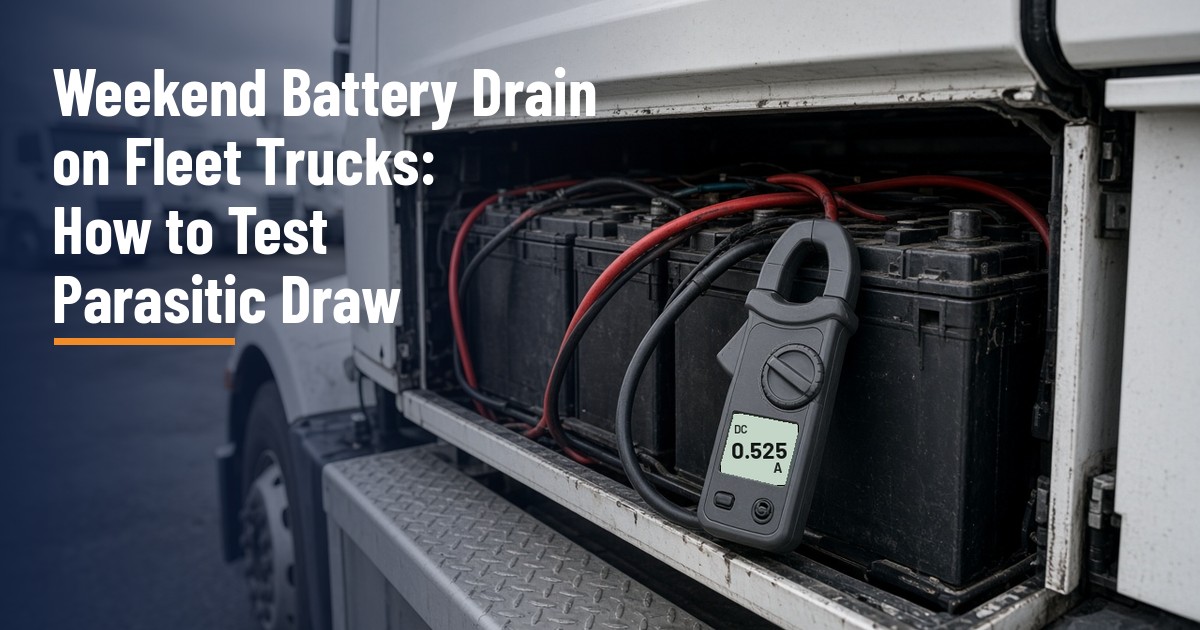
Then match the size of the drain to the complaint. In theory, a draw of about 1 A empties an 80 Ah battery in about 80 hours, which is about 3 to 4 days. A truck that dies over a two day weekend is likely losing amps, not milliamps. Real cranking trouble starts well before the battery is empty, around 11.5 to 12 V, so the actual time is shorter. Read the meter carefully: 0.525 A is 525 mA.
Set up the test without waking the truck
- Get access first. Make sure you can reach every fuse and relay panel and key modules before the truck goes to sleep.
- Trick the switches. Doors, hood and compartment switches can keep modules awake. Latch them or trick them closed so the truck thinks it is shut and parked.
- Keep power on the system. Put the ammeter or clamp in circuit before you disconnect anything, so the modules never lose power and reset. A reset wakes everything up and you start over.
- Let it sleep. Modules can stay awake for a while after key off. Check the OEM service information for sleep time, wait it out, and do not open doors or plug in a tool once you have a reading.
Find the circuit without pulling fuses
Pulling fuses one at a time can wake modules and reset the test. Instead, leave each fuse in place and measure the small voltage drop across it with a meter on the millivolt scale, touching the test points on top of the fuse without opening doors or waking the truck. A fuse with a voltage drop has current flowing through it. To estimate how much, use a voltage drop chart for that fuse type and rating, which converts millivolts to milliamps. Use the OEM fuse chart for your truck to identify the circuit. A thermal camera can also help spot a warm module or component on a steady drain. It will not show a fuse carrying a small drain, because a fuse only warms up near its rating.
When the drain test passes but the battery still dies
Some drains are intermittent. A module wakes the network every so often, and while it is awake, everything draws current. A short static test can miss it completely. Logging battery current over time, with a scope or recording meter set to trigger on a jump in current, catches the wake event. Then the question is which module woke the truck, not which parts drew current after it woke. Wiring diagrams that show which modules can wake the network help narrow it down. Our free diesel truck wiring diagrams are a good place to start.
Use the scan tool for evidence
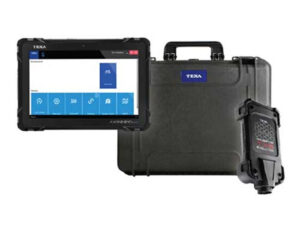
Before and after the drain test, scan every module. Communication codes, low voltage codes or a module that keeps logging events can point to the module that will not sleep. On supported vehicles, TEXA IDC6 Truck reads codes and live data across many modules in one session. Coverage varies by make, model and year.
Keep voltage stable while you diagnose
Long scan sessions and module programming pull the batteries down, and low voltage during programming can cause real trouble. A battery support charger holds voltage steady while the truck is on the bench. The GYSFLASH 121.12 CNT is a high output battery support charger rated 120 A on 230 V and 100 A on 110 V. Do not leave a support charger connected during the drain test itself, since it will hide the draw.
Build the diagnostic habit
Finding the cause, not just the symptom, is a skill. Mechanic Mindset’s Diagnostic Coach is online diagnostic training from Darren Quinn built around a step-by-step method for testing before replacing parts, which fits battery drain diagnostics well. Defy Diagnostics is an affiliate of Mechanic Mindset; the training is theirs. As Mechanic Mindset’s current offer, subject to change, the annual plan includes a free multimeter and sensor simulator.
Support from Defy Diagnostics
Active TEXA users get remote support from Dave, 9 to 5 ET, covering tool hardware and software, plus remote training on using the tool. We help with setup and activation so your team can get to work faster. TEXA tools from Defy carry a 1-year warranty. Browse our TEXA diesel and heavy duty diagnostic kits or call 864-803-3744 or email Dave@DefyDiagnostics.com for a kit quote.
Frequently asked questions
What is a normal parasitic draw on a heavy truck?
Heavy trucks have their own OEM sleep draw limits, and added equipment such as telematics can change them. The 20 to 50 mA figure often quoted applies to most cars and light trucks. Check the OEM spec for your truck.
Why does my fleet truck die over the weekend?
Common causes are a module that does not go to sleep, added equipment wired to constant power, a weak battery or charging fault, or a module that wakes the network intermittently. Test the batteries and charging first, then do a parasitic draw test.
How do I find a parasitic draw without pulling fuses?
Leave the fuses in place and measure the small voltage drop across each one with a meter on the millivolt scale. A fuse with a drop has current flowing through it, and a chart for that fuse type and rating converts millivolts to an approximate current, so you can find the circuit without waking the system.
Why did my drain test pass when the battery still goes dead?
The drain may be intermittent. A module can wake the network every so often. Logging battery current over time with a trigger catches the wake event a short test misses.
Can I use a battery charger during a drain test?
No. A charger or support unit hides the draw. Use a battery support charger during long scan or programming sessions, and disconnect it before the drain test.
Talk to a Diagnostic Expert
Questions about battery support chargers or TEXA IDC6 Truck coverage? Call 864-803-3744 or email Dave@DefyDiagnostics.com.