
“What happens if that radar up front is off by half a degree?”
If you manage Class 7 or Class 8 trucks, that question is no longer hypothetical. Advanced Driver Assistance Systems (ADAS), forward collision warning, lane departure warning, adaptive cruise, blind spot monitoring, pedestrian braking, are now standard or strongly encouraged in most new commercial vehicles, and fleets are rapidly adopting them to reduce crashes and insurance exposure.
Here’s the problem: These systems only work if they are calibrated correctly.
A bent bracket, a windshield replacement, a bumper impact in a yard at 3 mph, an alignment adjustment… any of that can nudge a camera or radar out of spec. When that happens, the truck may think there’s a threat that isn’t there, or worse, fail to react to the threat that is. That’s a safety issue, a liability issue, and now, in many cases, an insurance documentation issue.
In this article, we’re going to walk through:
- Why ADAS is no longer “car tech”, it’s diesel tech.
- The real risk of running uncalibrated ADAS on heavy trucks.
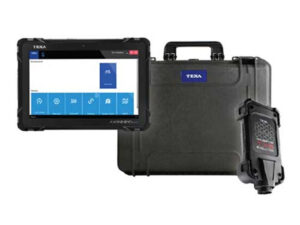
- How a calibration system like the TEXA CCS2 paired with IDC6 software gives fleets control instead of depending on dealers.
- A practical game plan you can start using immediately.
If you run trucks, run a shop, or sign off on repairs, this matters.
ADAS is now built into Class 7/8 trucks — and it’s changing fleet liability
Not long ago, “driver assistance” sounded like a luxury car feature. That’s over.
Today’s heavy-duty trucks are rolling with forward-facing radar for collision mitigation, cameras for lane-keeping, blind spot monitoring along the side of the cab/trailer, pedestrian automatic emergency braking, and adaptive cruise control that manages following distance in traffic. These systems are specifically designed to prevent or soften rear-end collisions, lane drift, pedestrian strikes, and rollover events, all high-cost events in commercial transport.
Here’s why that matters to you:
- Fewer accidents = direct cost avoidance. A single rear-end collision with injury can run into six figures fast.
- Insurers are watching. Many insurance carriers now expect proof that ADAS systems are functioning as designed, especially after repair. Some will require calibration documentation as part of a claim.
- DOT and legal exposure is rising. If a truck was equipped with lane departure warning or automatic emergency braking and that system failed due to improper calibration… attorneys will ask why.
Another important angle: drivers are using this tech and, for the most part, they like it. A recent survey found that 64% of truck drivers and 86% of carrier executives view ADAS positively because it reduces fatigue, improves awareness, and gives them backup in high-risk traffic situations.
So this is bigger than compliance. It’s now part of safety culture.
Practical application
If you run a fleet, you can no longer treat ADAS as “dealer tech.” You need, at minimum, a documented process for when calibration is required, who’s allowed to do it, and how that gets logged.

What ‘calibration’ actually means — and why being 0.5° off can cost you
Let’s make this simple.
Every ADAS function in a truck depends on sensors (camera, radar, lidar, ultrasonic) and control logic (software). Calibration is the process of teaching the truck exactly where those sensors are aiming in the real world.
If that aim is wrong:
- Automatic Emergency Braking (AEB) may not trigger when a stopped vehicle is ahead.
- Lane departure warning can “see” a lane line that isn’t there and start yelling at the driver for no reason.
- Blind spot intervention can try to correct when nothing is actually in the blind spot, which can jerk the vehicle or spook the driver.
Heavy trucks live hard lives. Common calibration disruptors:
- Windshield replacement (camera moved a few millimeters).
- Front bumper/hood repair, tow hooks, grille guard install.
- Front-end alignment or ride height change (leveling kits, new springs).
- Collision (even “minor” parking-lot contact).
- Frame work.
Here’s where fleets get burned: “The truck drives fine.”
Yeah, until the tech who did the glass job never recalibrated the forward camera. Two weeks later, the driver says lane keep is “fighting me for no reason.” That’s not just annoying. That’s documented malfunction.
From a legal standpoint, uncalibrated ADAS after a repair is now being framed as “incomplete repair,” not “nice-to-have extra.” That means liability can shift toward the fleet or shop if something happens and the system is proven out-of-spec.
Step-by-step: how proper calibration is supposed to work
- The truck is positioned on a level surface at a defined distance from calibration targets.
- High-precision physical targets (radar reflectors, camera boards, etc.) are aligned to OEM spec.
- A calibration tool communicates with the vehicle via diagnostic software.
- The system learns “this is straight ahead, this is level, this is your distance.”
- A report is generated and stored.
This is exactly what the TEXA CCS2 calibration system is built to do: position and align targets with repeatable accuracy, then pair that with IDC6 software to walk the tech through brand-specific procedures and finalize the calibration with documented proof. (More on that next.)
Common mistakes to avoid
- “Eyeballing” placement of targets.
- Trying to reuse light-duty targets/stands on a Class 8 truck (geometry is different).
- Skipping post-repair calibration because “it was only a bumper.”
- Not saving the calibration report.
Expert angle
Insurance and safety experts are openly warning that improper ADAS calibration can lead to unexpected braking, false alarms, and increased crash risk, which directly exposes the repairer.

How fleets can bring ADAS calibration in-house with TEXA CCS2 + IDC6
Let’s talk solutions, not scare tactics.
The TEXA CCS2 ADAS calibration system and TEXA IDC6 software give you a repeatable, OEM-guided process to calibrate cameras, radar, and other driver assistance sensors on commercial trucks in your own facility, without hauling the truck to the dealer every time someone sneezes on a bumper.
Here’s how that creates value for a fleet or shop:
- Cost control
- Dealer ADAS calibration is billable shop time, plus transport, plus downtime.
- With CCS2, you set up the jig, follow IDC6 on-screen instructions, and generate a calibration certificate in-house. That’s recoverable labor you can bill internally (or even offer as a service line to other fleets).
- Uptime / downtime reduction
- Every day a truck is parked waiting on outside calibration is a day it’s not producing revenue.
- In-house calibration means you can get a unit back in service same-shift after glass work or a minor repair instead of losing it for 2-3 days.
- Documentation trail
- IDC6 produces step-by-step guided procedures and stores the result. That creates a calibration record that can be attached to a repair order, insurance claim file, or internal safety log, which is increasingly being requested post-incident.
- That record protects you. “Yes, this camera was calibrated to spec on this date at this mileage.”
- Consistency across brands
- Modern fleets are mixed fleets. You might have Freightliner, Kenworth, Volvo, Mack, International, Paccar, etc.
- TEXA is known for multi-brand support. With CCS2 hardware and IDC6 software, you’re not buying a ‘single OEM’ tool. You’re investing in coverage across your fleet mix, including the growing amount of radar- and camera-based ADAS in Class 7 and Class 8 trucks.
- Technician confidence
- IDC6 doesn’t just say “calibrate camera.” It walks your tech through setup: ride height requirements, distance to target, alignment references, environmental constraints.
- That turns “our glass guy doesn’t touch ADAS” into “our glass guy can close the loop and produce a calibration report.”
Timeline to implement
- Week 1: Acquire CCS2 and train one lead tech on IDC6 workflow.
- Week 2: Build a standard operating procedure (SOP): When calibration is required, who signs off, where reports are stored.
- Week 3: Start billing calibration work internally (and tracking downtime saved).
Success metrics
- Reduced outsourced calibration spend.
- Reduced vehicle downtime hours per incident.
- 100% of ADAS-related repairs have a calibration report attached to the RO.
- Fewer driver complaints about “lane keep pulling me” or false collision warnings.

The future is more automation, not less — and fleets that ignore calibration will get squeezed
Here’s the uncomfortable truth nobody likes to say out loud:
Driver assistance on heavy trucks is not going away. It’s going deeper.
Regulators are pushing collision-mitigation tech and pedestrian AEB into more vehicle classes. Adoption of systems like forward collision warning, lane keeping assist, blind spot monitoring, and pedestrian automatic emergency braking has surged from low double digits in the mid-2010s to well over 70–90% penetration across recent model years.
Insurers love fewer and less-severe crashes, and they’re starting to price premiums around that reality. Shops and fleets that can prove they did the calibration correctly are positioned to negotiate. Shops that “just sent it” are not.
Here’s the myth to kill right now:
“My veteran driver doesn’t need lane assist.”
That’s missing the point. ADAS is not about replacing the driver. It’s about stacking additional protection around the driver, the brand, and the asset. Think of it like a second set of eyes that never blinks and never gets tired at 2:14 AM on I-81 in the rain.
And every one of those “second sets of eyes” needs to be calibrated any time it’s touched.
Where this goes next:
- More automated braking and intervention, especially in urban environments and low-speed pedestrian encounters.
- More legal scrutiny after any crash involving a truck with AEB or lane keeping tech.
- More fleets doing in-house ADAS calibration (just like in-house regen, in-house trailer ABS, in-house tire pressure monitoring) instead of paying dealer rates every time.
The bottom line: CCS2 plus IDC6 gives you that control now. You don’t have to wait until it becomes mandatory and reactive. You can build it into your maintenance program proactively.

KEY TAKEAWAYS BOX
- ADAS is already built into today’s heavy-duty trucks, and it’s shaping safety policy, insurance expectations, and legal exposure.
- Improper or missing calibration after a repair isn’t a paperwork error, it’s a liability event waiting to happen.
- The TEXA CCS2 calibration system with IDC6 software lets fleets and shops perform OEM-spec ADAS calibrations in-house, with documentation.
- Your next competitive edge is uptime and proof. If you can return a truck to service fast and show the paperwork, you win.
Conclusion
If you run a fleet, you’re not just managing trucks anymore. You’re managing rolling sensor networks tied directly to safety outcomes, insurance costs, and brand reputation.
The shift is already here. ADAS features like forward collision warning, lane keeping assist, blind spot intervention, and pedestrian emergency braking are quickly becoming standard on Class 7 and 8 trucks. With that shift comes a new core responsibility: calibration.
Bringing ADAS calibration in-house with a system like the TEXA CCS2 and running guided procedures through TEXA IDC6 software is how smart fleets are protecting their people, protecting their insurance position, and protecting uptime. It moves you from “hoping it was set up right” to “we have proof it was done to spec.”
So here’s the question: Are you going to let someone else control that critical safety step, or are you going to own it?
If you’re serious about uptime, cost control, and protecting your drivers, now is the time to build an ADAS calibration process into your maintenance program. Talk to a Pro today!